Cycloaliphatic Amine Epoxy Hardener: YLH-3002 Failure Modes
Nov 17, 2026
Cycloaliphatic amine epoxy hardener YLH-3002 is a modified cycloaliphatic amine at AHEW 182 g/eq, 5000-12000 cps at 25 °C, and 96 phr on a 190 g/eq resin. Almost half the mixed mass ends up as hardener, and that load sets both the working window and the seven field defects documented in this report.
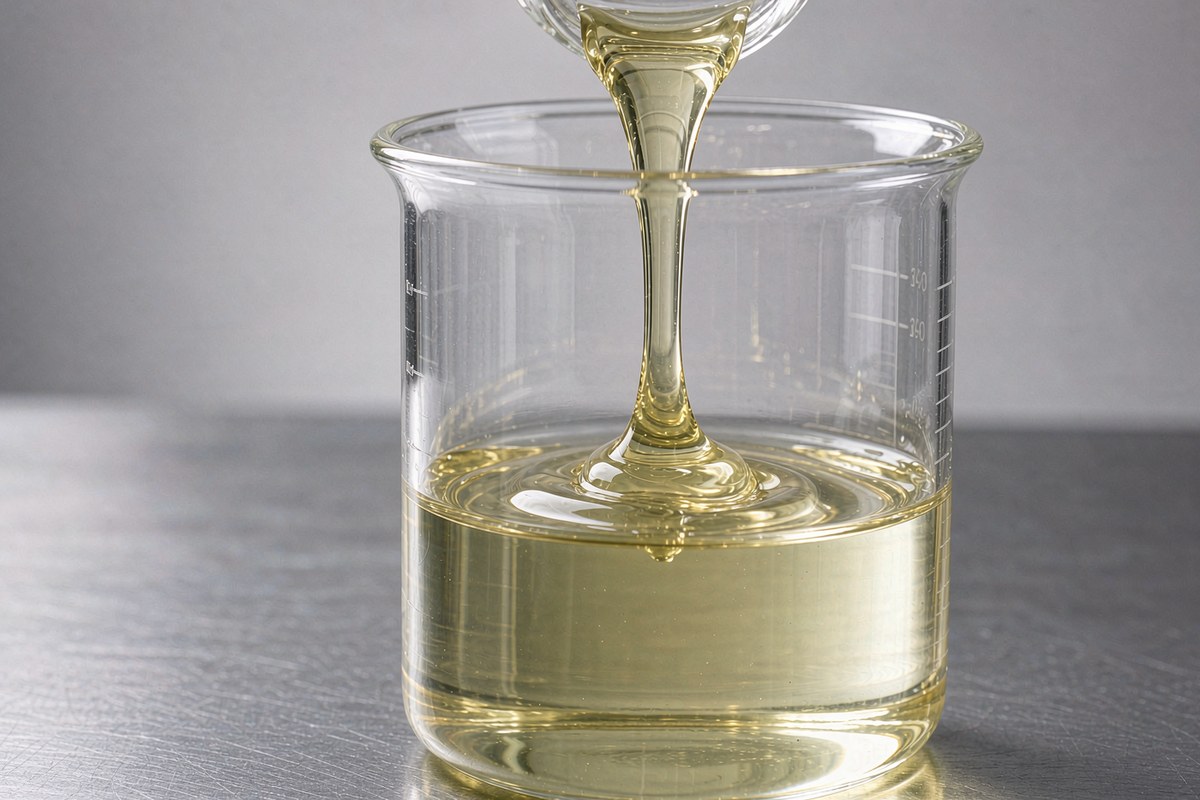
Figure 1. YLH-3002 as supplied: a transparent liquid thick enough to pour as a rope, at a Gardner colour ceiling of 1.
1. Introduction
Ambient-cure epoxy fails at the mixing bench more often than at the reactor. A hardener that pours at 15 °C and leaves 30 min of working time earns its price.
YLH-3002 sits at the heavy end of the family: 5000-12000 cps and 182 g/eq, far from the 92-100 g/eq flooring grades, and that distance changes metering, air release and the pattern of defects.
Seven defects follow, each with the arithmetic or mechanism behind it, plus where the grade does not fit.
2. Materials and Methods: Cycloaliphatic Amine Epoxy Hardener YLH-3002
2.1 Product Identification and Published Specification
The page publishes no CAS, no formula, no pack size and no shelf life, so identity rests on the batch documents.
Table 1. Identity and commercial data for YLH-3002.
Item
Information
Grade
YLH-3002
Chemical type
Modified cycloaliphatic amine hardener
CAS No.
Not published
Appearance
Transparent viscous liquid
Table 2. Published specification of YLH-3002 at 25 °C.
Property
Value
Colour, Gardner
Max. 1
Viscosity at 25 °C
5000-12000 cps
AHEW
182 g/eq
Amine value
290 mg KOH/g
Density at 25 °C
1.04 g/cm³
Added weight
96 PHR
Table 3. Cure response and mechanical data on a liquid bisphenol A resin of EEW 190.
Test
Result
Gel time, 100 g mix at 25 °C
30 min
Thin film set, 15 g at 3 mm, 25 °C
1.5 h
Shore D 70, 15 g at 3 mm, 25 °C
6 h
Bending failure load
227 N
Bending strength
84.1 MPa
Tensile failure load
2352 N
Tensile strength
54.1 MPa
Table 3 holds only for that resin; a 170 g/eq grade changes phr and cured strength.
2.2 Test Methods and Data Sources
Colour is read according to ASTM D1544, amine value by ISO 9702 titration, water content according to ASTM E203; the page does not say which were run.
Derived values (phr, equivalents per kg, volume ratio) reproduce on a calculator. Mechanical figures carry no standard deviation, so 84.1 MPa is nominal at n = 1.
The amine numbers do not close: 56,100 ÷ 290 = 193.4 g/eq, 6% above the published 182. The phr line settles it: 100 × 182 ÷ 190 = 95.8 matches the published 96, and 193.4 would ask 101.8.
3. Results and Discussion: Hardener Load and Network Density
3.1 What 96 phr Does to the Cured Network
At EEW 190 the 96 phr load puts 95.8 g of hardener against 100 g of bisphenol A resin: hardener is 48.9% of the mix and amine equivalents reach 2.69 per kilogram.
Sibling grades run denser: 3.42 eq/kg for low-viscosity YLH-3023, 3.47 for YLH-6004 polyetheramine hardener, 3.53 for YLH-9101, since 92-100 g/eq equivalents leave less inert mass per crosslink. Hence 21-24% fewer crosslink points, bending at 84.1 MPa against 96.3 MPa, tensile level at 54.1 against 54.0 MPa.
Early hardness breaks the pattern: Shore D 70 in 6 h against 7-15 h, which is kinetics rather than density, since 290 mg KOH/g keeps reactive groups close together.
3.2 Comparison with Alternative Systems
For this cycloaliphatic amine epoxy hardener, specify in one order: viscosity for the process, AHEW for the ratio, equivalents per kg for the network.
Table 4. YLH-3002 against three hardeners from the same catalogue, all on EEW 190.
Property
YLH-3002
YLH-3023
YLH-6004
YLH-9101
AHEW, g/eq
182
100
96
92
Viscosity, 25 °C, cps
5000-12000
250-500
100-300
250-450
Gardner colour, max
1
1
3
2
phr at EEW 190
96
52
50
48
Gel time, 100 g, min
30
30
50
30
Shore D 70, h
6
7
15
8
Bending strength, MPa
84.1
78
96.3
91.7
Amine eq per kg of mix
2.69
3.42
3.47
3.53
A 5000-12000 cps hardener in a plant built for 100-300 cps pumps is a pump problem first. Warm both parts to 30-35 °C and viscosity halves; at 15 °C it starves. If the line cannot be heated, take a 250-500 cps grade.
YLH-3023 and fast-cure YLH-9101 share a 30 min gel yet differ by 13.7 MPa in bending.
4. Formulation and Dosage Calculation
The ratio follows one line: phr = 100 × AHEW ÷ EEW, so 100 × 182 ÷ 190 = 95.8 phr.
Table 5. Hardener demand across the EEW range handled by YLH-3002.
Resin EEW, g/eq
phr by weight
Hardener share
Per 100 kg resin
170
107.1
51.7%
107.1 kg
182
100.0
50.0%
100.0 kg
190
95.8
48.9%
95.8 kg
200
91.0
47.6%
91.0 kg
250
72.8
42.1%
72.8 kg
Hardener is 42-52% of the mixed mass here, so hardener price drives compound cost more than resin price. Moving from EEW 190 to a 170 g/eq bisphenol F grade lifts phr to 107.1, an 11.8% step a fixed 1:1 kit cannot absorb.
By volume the pair sits closer: 95.8 g of hardener at 1.04 g/cm³ fills 92.1 cm³ against 86.2 cm³ of resin, a ratio of 1.07:1.
If a 1:1 volume kit was built for a thinner hardener, it under-doses: one volume to one delivers 1.04 ÷ 1.16 × 100 = 89.7 phr, 6.4% short of 95.8.
5. Processing Notes and Operating Window
Induction earns its minutes. Stand the mix 10-15 min so air can rise while viscosity still allows it; when the shop is cold, allow 20 min.
Weigh both components: a 2% error moves phr two points and leaves the surface tacky for a day while the bulk reads hard.
Temperature sets the clock. The 30 min gel and 1.5 h film set were measured at 25 °C; at 15 °C working life doubles and Shore D 70 takes three times as long. Cap the batch mass: a 25 kg pail gels sooner.
Table 6. Seven field defects, their mechanisms and the corrective action for each.
Symptom
Mechanism
Corrective action
Cost
Greasy, soapy film
Amine plus CO2 and water forms carbamate
Induct 10-15 min, apply 15-25 °C, RH under 75%
Second coat peels
Tacky surface at 24 h
Under-weighed hardener; a 1:1 kit gives 89.7 phr
Meter 96:100 by weight or 1.07:1 by volume
Failed hardness check
Pinholes in a cast
5000-12000 cps holds air; gel closes first
Degas at 5 mbar for 5 min
Voids weaken the section
Bending at 84 MPa, not 96
2.69 eq/kg against 3.5 for thin grades
Specify YLH-6004 where stiffness leads
Overbuilt joints
Gel in a 25 kg pail
The 100 g gel time does not scale
Batches 5-10 kg, or chill to 18 °C
Lost batch
Soft part after 12 °C night
Reactivity falls below 15 °C
20-25 °C for 6 h, or post-cure 60 °C for 2 h
Rework, early release
Bond line lifts on damp steel
Water blocks wetting; blush layer forms
3 °C dew point margin, abrade, solvent-wipe
Adhesive failure
Figure 2. Adding hardener at 96 phr: the pour is slow, the induction is not optional, and batch mass is the first thing to cap.
6. Applications
The page lists epoxy adhesives and transparent A/B glue, both leaning on Gardner 1 colour and 54.1 MPa tensile strength.
Table 7. Where YLH-3002 fits and what each process constrains.
Process
Why YLH-3002 fits
Constraint
Transparent two-part adhesive
Gardner 1 keeps a 2-3 mm bond line invisible
30 min gel caps open time
Metal and ABS bonding
54.1 MPa tensile, 227 N bending load
Degrease and abrade; remove blush
Small-part repair
Shore D 70 in 6 h returns the part in one shift
Sections above 10 mm run hot when poured in one shot
Transparent bonding is the natural fit: a 2-3 mm bond line stays invisible and Shore D 70 arrives in 6 h. Deep casting is not, because 5000-12000 cps holds air and 30 min gel leaves no window for degassing.
Figure 3. Clear A/B adhesive on a steel and ABS joint: colour and tensile strength carry the application, viscosity and open time limit it.
7. Limitations and Material Verification
7.1 Known Limitations and Where the Grade Does Not Fit
- No CAS number or formula on the page. Tie identity to the batch COA, not a bare grade name.
- AHEW 182 and amine value 290 mg KOH/g differ by 6%. Pick one basis and record it.
- Chemical resistance is claimed, not quantified; at 2.69 eq/kg check with an immersion test.
- No Tg, HDT or elongation is published, so 84.1 MPa sits off any stiffness curve.
- Not for thin castings, pumps capped at 500 cps, or work below 15 °C.
- Colour drifts in an open drum as Gardner 1 material takes up CO2 and moisture.
7.2 Incoming Inspection, Packaging, Storage and Safety
Verify three numbers on receipt: amine value by ISO 9702 titration, colour according to ASTM D1544, viscosity at 25 °C against the 5000-12000 cps window. Add an ASTM E203 water check if the drum was open or stored cold.
Pack size and shelf life are not published; settle both on the quotation. Storage: ventilated area, clear of flame, cap closed after use.
Safety data belongs in the MSDS; cycloaliphatic amines are corrosive and skin-sensitising by class. RoHS and REACH statements are not published for YLH-3002, so ask per shipment. Where a TDS, MSDS or COA differs from this report, the batch document governs.
8. Frequently Asked Questions
What is the mix ratio of YLH-3002 with a 190 g/eq epoxy resin?
96 phr by weight, or 96 g per 100 g of resin, from 100 × 182 ÷ 190 = 95.8. By volume the pair runs 1.07:1, since the hardener is lighter at 1.04 g/cm³.
Why does YLH-3002 need 96 phr when other cycloaliphatic hardeners need about 50 phr?
AHEW sets it: YLH-3023 at 100 g/eq and YLH-9101 at 92 g/eq carry twice the active hydrogen per gram, so the resin needs half the mass. Networks differ too: 2.69 eq/kg against 3.42-3.53.
Can YLH-3002 be used below 15 °C?
Not without a heated room. The 1.5 h film set and 6 h Shore D 70 were measured at 25 °C, and amine cure slows sharply below that. Hold 20-25 °C for 6 h.
Does YLH-3002 cause amine blush?
It can, on damp days: free amine reacts with CO2 and water into a carbamate that feels soapy and blocks intercoat adhesion. Induction, 15-25 °C and RH under 75% cut most of the risk.
Is YLH-3002 suitable for clear castings and optical parts?
For colour yes, for thickness no. Gardner max 1 keeps a 2-3 mm section clear, but 5000-12000 cps holds air and 30 min gel leaves no time to degas. Bond with it, cast with YLH-3023 at 250-500 cps.
How long does YLH-3002 keep in the drum?
The page publishes no shelf life. Ask for the batch date on the COA, keep the drum closed, and re-run the amine value titration before using older material.
9. Conclusions
YLH-3002 is a 182 g/eq modified cycloaliphatic amine asking 96 phr on a 190 g/eq resin, and delivers 84.1 MPa bending, 54.1 MPa tensile and Shore D 70 in 6 h. Its 5000-12000 cps body and 48.9% share explain most defects seen with it, but the ratio stays a starting point until the COA confirms AHEW.
Three checks cover the common failures: meter 96:100 by weight, hold the shop at 20-25 °C, avoid thick sections. Where stiffness or air release leads, a 92-100 g/eq grade such as YLH-6004 or YLH-6005 modified polyetheramine beats a workaround.
10. References
1. Yolatech product page for YLH-3002: https://www.yolatech.com/curing-agnet-ylh-3002 (accessed 2026-11-17).
2. Yolatech Technical Data Sheet (TDS) for YLH-3002 (available on request).
3. Yolatech Material Safety Data Sheet (MSDS) and Certificate of Analysis (COA) for YLH-3002.
4. ASTM D1544, Gardner color of transparent liquids.
5. ISO 9702, amine group nitrogen content of amine epoxide hardeners.
6. ASTM E203, water content by Karl Fischer titration.
7. Yolatech product page for YLH-3023: https://www.yolatech.com/curing-agnet-ylh-3023 (accessed 2026-11-17).
Mehr lesen






 IPv6-Netzwerk unterstützt