


Sprache
:

Sprache
:
Tetrafunctional epoxy curing agent YLD-1240 is a nitrogen-containing isophthalamine epoxy resin with four glycidyl groups per molecule at EEW 95-110 g/eq. Viscosity is 1600-3000 cps at 25 °C and color is APHA 5 maximum. CAS 63738-22-7. Four epoxides per molecule give the crosslink density of a cure.
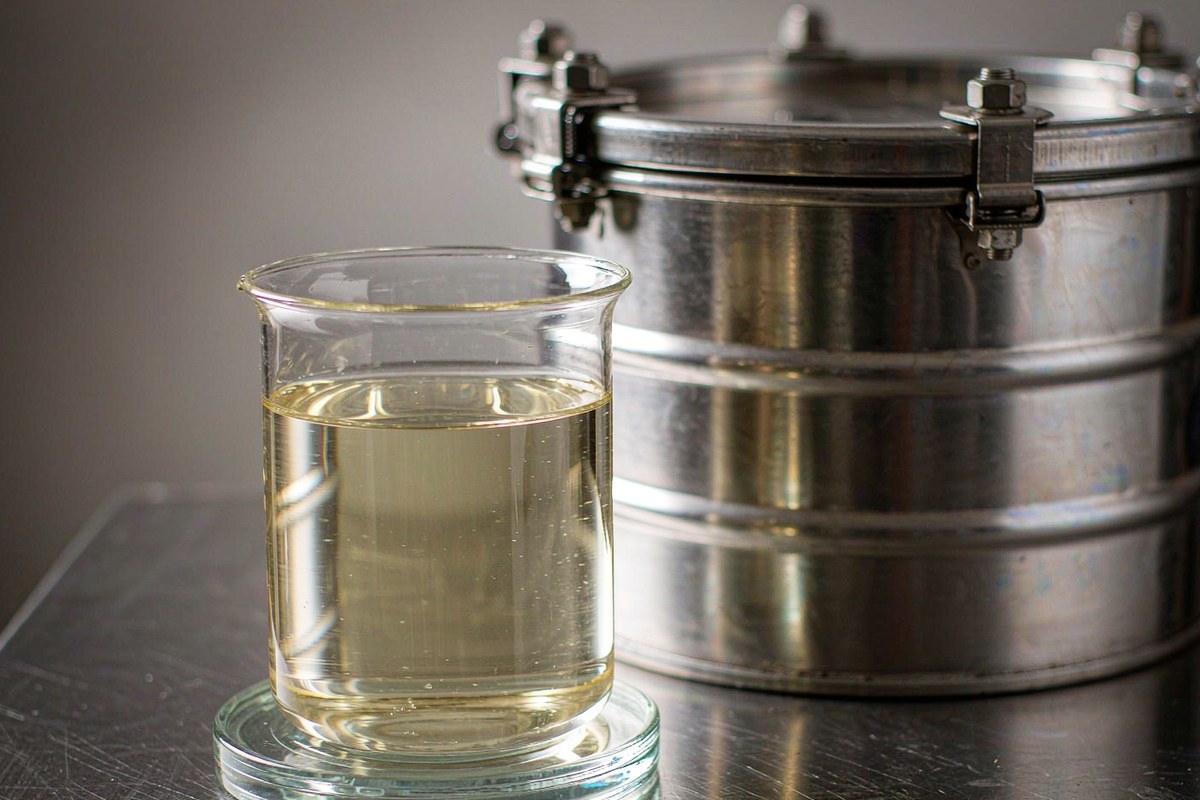
Figure 1. Curing agent YLD-1240 is supplied as a pale yellow liquid in steel drums.
Heat resistance and chemical resistance in an epoxy network come from crosslink density, and crosslink density comes from functionality. Highly functional epoxy resins are often solid or semi-solid, forcing heating or solvent into the process.
The grade keeps four epoxide groups per molecule in a liquid that pours at 1600-3000 cps at 25 °C. The YLD-1240 product page calls it an isophthalamine type tetrafunctional epoxy resin, nitrogen-containing and highly reactive, listed under Curing Agent.
A standard liquid bisphenol A epoxy resin YLE-128 runs at 11000-15000 mPa·s. YLD-1240 is roughly five to seven times thinner across the published windows.
Values below come from the public product page; derived constants are marked calculated.
Table 1 collects the identity and specification data published for the grade.
Table 1. Identity and published specification of tetrafunctional epoxy curing agent YLD-1240 (calculated constants marked).
Item |
Information |
Product name |
Curing agent YLD-1240 |
Chemical name |
N,N,N',N'-Tetrakis(oxiranylmethyl)-1,3-benzenedimethanamine |
CAS No. |
63738-22-7 |
Functionality |
4 epoxide groups per molecule |
Appearance |
Pale yellow liquid |
Color, APHA |
Max. 5 |
Epoxy equivalent weight |
95-110 g/eq |
Viscosity at 25 °C |
1600-3000 mPa·s (cps) |
Molecular weight and theoretical EEW |
360.45 g/mol for C20H28N2O4; 90.1 g/eq (calculated) |
Epoxy equivalent weight is determined by titration according to ASTM D1652 or ISO 3001, and the figure on the current TDS governs. Viscosity is reported at 25 °C by the method stated in the same document.
Color is reported on the APHA scale, but the page does not name the method. Where water content matters it is determined by Karl Fischer titration under ASTM E203.
Incoming inspection of a glycidyl amine lot is normally run in duplicate, or as n = 3 determinations from separate drum positions.
Two published facts define the grade: four epoxide groups per molecule and an EEW window of 95-110 g/eq.
Structurally, YLD-1240 is the tetraglycidyl derivative of m-xylylenediamine MXDA, CAS 1477-55-0. Glycidylation of the two primary amine groups leaves a tertiary amine nitrogen carrying two epoxide arms, so four epoxides sit on one meta-substituted benzene ring.
The calculated molecular weight is 360.45 g/mol, putting the theoretical EEW at 90.1 g/eq. The published window of 95-110 g/eq sits 5-20 g/eq above that, consistent with residual partially glycidylated material in a technical grade. Treat the published window as the specification.
The aromatic ring plus four epoxides gives the dense network the product page calls high crosslinking density. The two tertiary amine nitrogens are expected to accelerate anhydride cure and epoxy homopolymerization; that effect size is not published; in practice it must be confirmed on your own cure schedule.
Table 2 places YLD-1240 beside three amine hardeners from the same catalogue.
Table 2. Property comparison of tetrafunctional epoxy curing agent YLD-1240 with alternative amine systems (published values).
Property |
YLD-1240 |
MXDA |
DETDA |
PACM |
Catalogue role |
Tetrafunctional epoxy curing agent |
Diamine hardener |
Aromatic diamine hardener |
Cycloaliphatic diamine hardener |
Reactive groups per molecule |
4 epoxide |
4 amine hydrogen |
4 amine hydrogen |
4 amine hydrogen |
Epoxy equivalent weight |
95-110 g/eq |
Not applicable |
Not applicable |
Not applicable |
Amine hydrogen equivalent |
Not applicable |
34.1 g/eq (calculated) |
Not published |
Not published |
Color limit |
APHA 5 maximum |
APHA 20 maximum |
Not published |
APHA 30 maximum |
Water content |
Not published |
Max. 0.50% |
Max. 0.10% |
Max. 0.20% |
The table separates two sides of the stoichiometry. YLD-1240 is the only epoxide-functional entry, while MXDA, diethyltoluenediamine DETDA and diaminodicyclohexylmethane PACM carry amine hydrogen. A blend that contains both consumes hardener on the total epoxide count.
If a formulation needs amine functionality only, the amine hardeners in Table 2 are the direct answer and YLD-1240 is the wrong tool. The grade earns its place where the target is crosslink density in a low-solvent system.
The grade is dosed on total epoxide stoichiometry. The blend EEW of a base resin and YLD-1240 mixture equals (100 + d) divided by (100 divided by the base resin EEW plus d divided by the EEW of YLD-1240), where d is the loading in phr.
Hardener demand then follows phr = 100 × AHEW ÷ blend EEW. Table 3 works the example on a bisphenol A resin at 187 g/eq, the midpoint of the published 184-190 g/eq window for YLE-128, with high-purity diethylenetriamine DETA at a calculated AHEW of 20.6 g/eq.
Table 3. Worked dosage examples: blend EEW and amine hardener demand for YLD-1240 loadings in a bisphenol A epoxy resin at 187 g/eq.
YLD-1240 loading, phr |
Blend EEW, g/eq |
Amine hardener demand, phr |
0 |
187.0 |
11.0 |
10 |
174.0 |
11.8 |
20 |
164.4 |
12.5 |
30 |
157.1 |
13.1 |
The direction of the effect is the point. YLD-1240 carries roughly half the epoxide equivalent weight of the base resin, so each added part lowers the blend EEW and raises the amine hardener demand.
The trade is simple: more hardener per 100 parts, in exchange for four epoxides per molecule and a denser network. Whether it pays depends on the service temperature the part has to hold.
Keep a first trial between 10 and 30 phr. Above about 40 phr the base resin properties are diluted and the hardener demand climbs toward 14 phr at 50 phr.
The operating window is set by reactivity and humidity, not by viscosity.
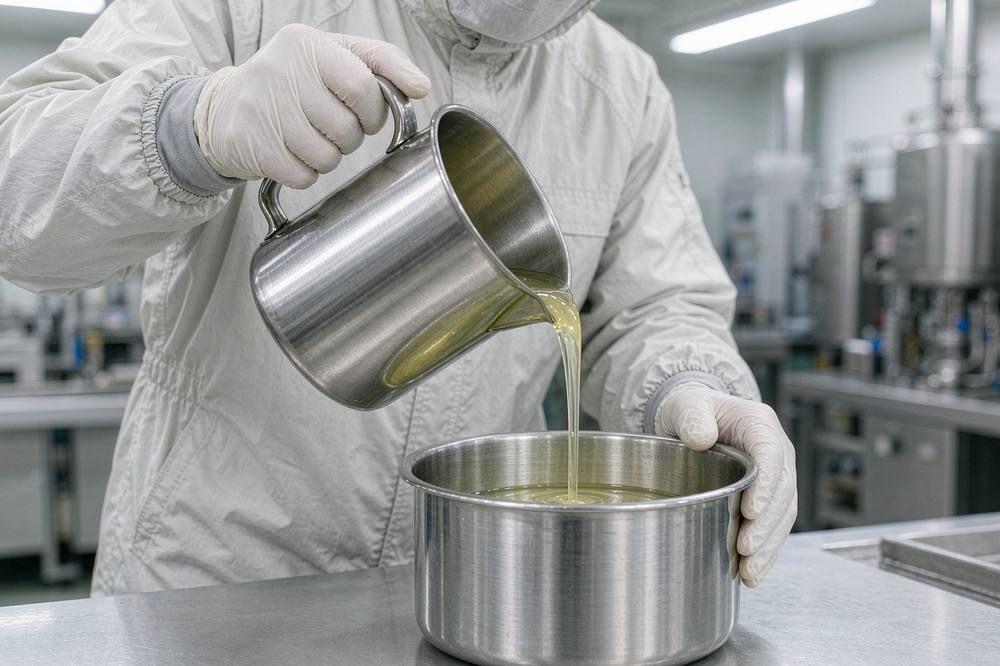
Figure 2. The YLD-1240 charge is weighed into the base resin and homogenized before the amine hardener is dosed.
The product page lists four applications for YLD-1240. Table 4 links each one to what four epoxides per molecule contribute.
Table 4. Applications listed on the YLD-1240 product page and the contribution of tetrafunctionality.
Application |
Contribution from four epoxides per molecule |
Practical note |
Chemical resistant coatings |
Dense network, lower permeability |
Tank linings and chemical storage areas |
Laminate |
High functionality for heat-resistant laminates |
Check Tg against the service temperature |
Composites |
Crosslink density and modulus |
Watch brittleness at high loading |
Adhesive |
Heat and chemical resistance |
Joint design and gap filling still govern |
Chemical resistant coatings come first: a dense network lowers permeability, which is what a tank lining needs.
Laminate, composites and adhesives share the same mechanism: high functionality raises crosslink density, and crosslink density raises heat resistance and modulus. The same density is the limitation, because a highly crosslinked network is brittle.
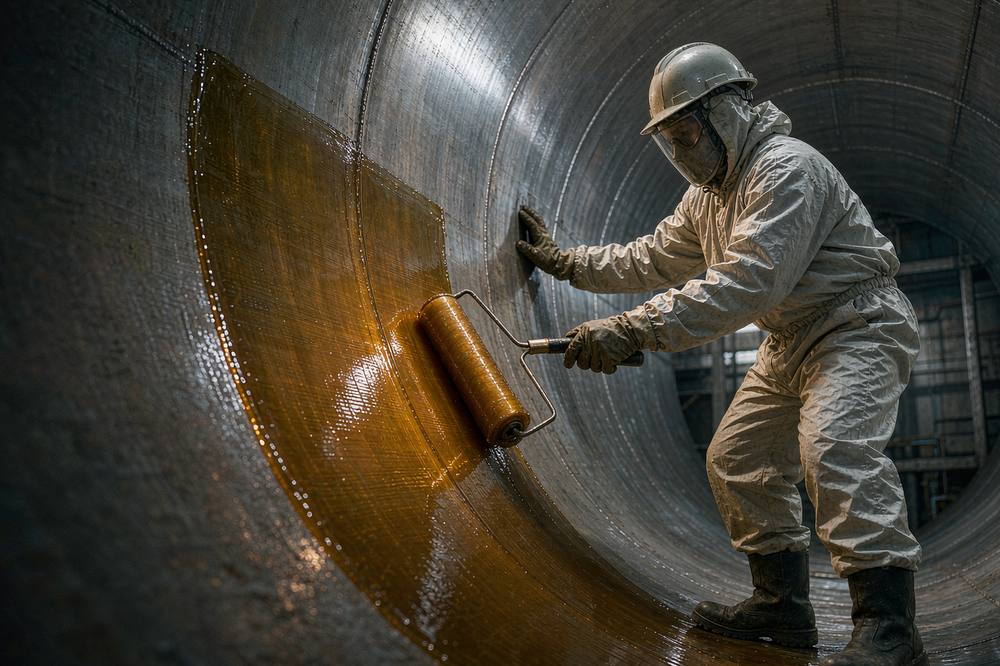
Figure 3. Roller application of a protective epoxy lining inside a chemical storage tank, the first application listed on the YLD-1240 product page.
The product page publishes four specification items: appearance, color, EEW and viscosity. Hydrolyzable chlorine, water content, density, flash point, gel time and Tg are not published; the current TDS, MSDS and COA govern.
The catalogue entry and the page also disagree on the grade designation: the URL of the product page carries a different code from the grade name shown on it, so confirm the designation on the quotation and the COA.
This grade is not the right choice if long pot life at ambient temperature is the priority, if a published flash point is needed for transport, or if the part is loaded in impact rather than heat and chemicals.
Incoming checks worth running on each lot are EEW by titration, color on the published scale, viscosity at 25 °C and water content by Karl Fischer titration, run in duplicate or as n = 3 when a lot is critical.
The page states drum package and at least 6 months shelf life from the date of manufacture in the original packing at ambient temperatures, in a well-ventilated, cool area.
Glycidyl amines are reactive nitrogen-containing materials, so handling, ventilation and personal protection follow the current MSDS. Any statement about REACH, RoHS or UL 94 must be verified against the documents issued for the specific lot; nothing here implies certification.
The grade is an isophthalamine type tetrafunctional epoxy resin, N,N,N',N'-tetrakis(oxiranylmethyl)-1,3-benzenedimethanamine, CAS 63738-22-7, with four glycidyl groups per molecule at EEW 95-110 g/eq and APHA 5 maximum.
Both descriptions appear on the site. The catalogue lists it under Curing Agent, and the product page calls it a tetrafunctional epoxy resin. The molecule is epoxide-functional, so it is dosed on total epoxide stoichiometry with an amine hardener, and the tertiary amine in its backbone can also accelerate cure.
MXDA and DETDA are amine-functional hardeners, while YLD-1240 is epoxide-functional and brings four epoxides per molecule. The color limit is tighter at APHA 5 maximum against APHA 20 for MXDA, and the viscosity is higher than a water-thin diamine.
Start between 10 and 30 phr. At 20 phr in a resin at 187 g/eq the blend EEW falls to about 164 g/eq and the DETA demand rises from 11.0 to 12.5 phr. Above 40 phr the base resin properties are diluted.
It raises it. The EEW of 95-110 g/eq is roughly half the 184-190 g/eq of a standard bisphenol A resin, so each added part lowers the blend EEW and increases the amine hardener demand; the trade is density.
The page states at least 6 months from the date of manufacture in the original packing at ambient temperatures, in a well-ventilated, cool area. Keep drums closed between draws, because water picked up in humid conditions consumes hardener and shifts the stoichiometry.
Published values for the grade are EEW 95-110 g/eq, 1600-3000 cps at 25 °C, APHA 5 maximum and pale yellow liquid appearance, in drum package with at least 6 months shelf life.
Its value is a liquid carrier of four epoxides per molecule: crosslink density for heat and chemical resistance without the heating or solvent a solid resin needs, at the cost of higher amine hardener demand.
Dose on total epoxide stoichiometry, keep a first trial between 10 and 30 phr, and confirm the unpublished items against the current TDS, MSDS and COA.
1. Product page, Curing agent YLD-1240, Yolatech: https://www.yolatech.com/curing-agent-ylh-102g4.
2. Product page, m-Xylylenediamine MXDA CAS 1477-55-0, Yolatech: https://www.yolatech.com/m-xylylenediamine-mxda-cas-1477-55-0
3. Product page, Diethyltoluenediamine DETDA CAS 68479-98-1, Yolatech: https://www.yolatech.com/diethyltoluenediamine-detda-cas-68479-98-1
4. Product page, 4,4'-Diaminodicyclohexyl methane PACM CAS 1761-71-3, Yolatech: https://www.yolatech.com/44-diaminodicyclohexyl-methane-pacm-cas-1761-71-3
5. Product page, liquid bisphenol A epoxy resin YLE-127 / YLE-128, Yolatech: https://www.yolatech.com/bisphenol-a-epoxy-resin
6. Technical Data Sheet, Material Safety Data Sheet and Certificate of Analysis for Curing agent YLD-1240, Yolatech (on request).
7. ASTM D1652, ISO 3001 and ASTM E203: titration routes for epoxy equivalent weight and water content.

 IPv6-Netzwerk unterstützt