DMTDA Chain Extender: Stoichiometric Dosage and Blend Ratios
Oct 10, 2026
DMTDA, dimethyl thio-toluene diamine (CAS 106264-79-3), is a liquid aromatic diamine used as a polyurethane chain extender and epoxy curing agent. Its published specification lists diamines at 95% minimum, water at 0.10% maximum and amine value 515-535 mg KOH/g. Epoxy equivalent weight is 53.6 g/eq.
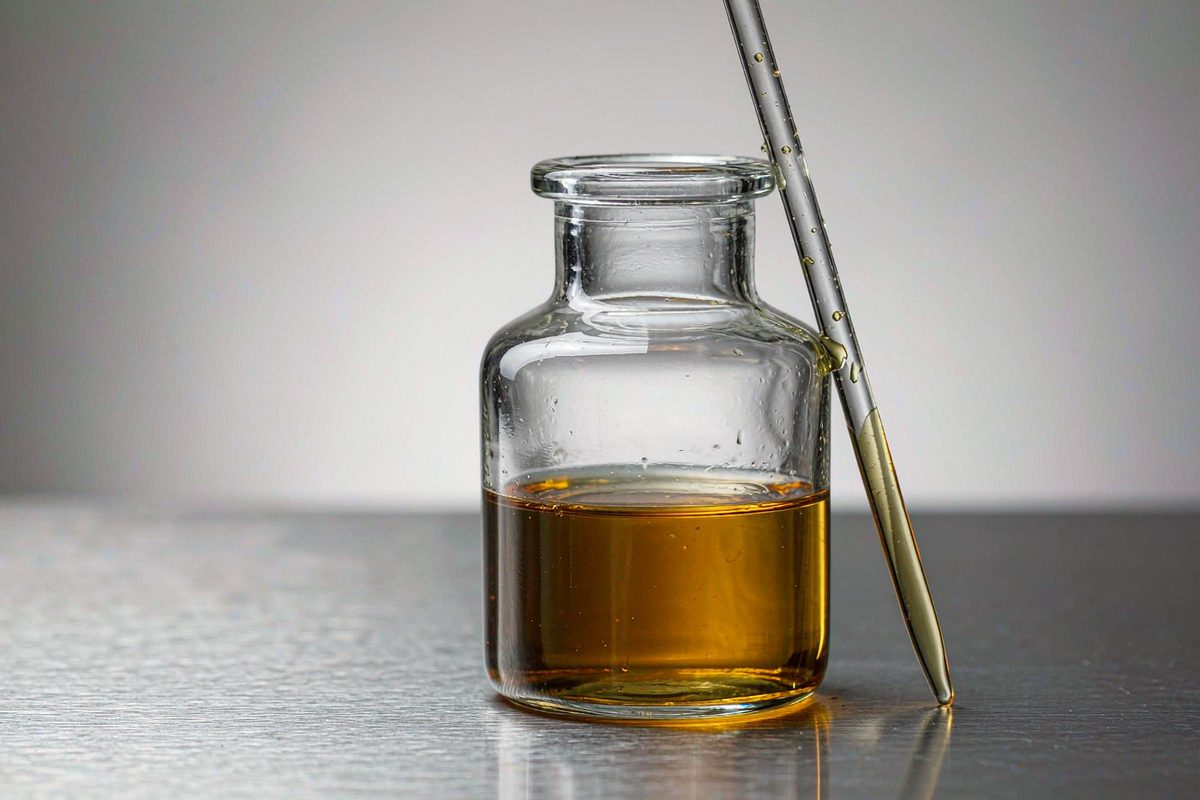
Figure 1. DMTDA as supplied: a light yellow liquid in a glass sample bottle.
Product Code: DMTDA
Chemical Name: Dimethyl thio-toluene diamine
CAS No.: 106264-79-3
Product Category: Aromatic diamine chain extender and epoxy curing agent
1. Introduction
DMTDA (CAS 106264-79-3) is a room-temperature liquid aromatic diamine that removes the melt step solid curatives require. Cast polyurethane elastomers and polyurea coatings use aromatic diamines because the rigid ring lifts hardness, modulus and heat resistance above what a polyether amine reaches. The price is reactivity.
The published specification is short: appearance, diamine content, toluenediamine (TDA) content, water and amine value. Everything else, from equivalent weight to blend ratio, has to be derived.
All numbers come from the public product page. Constants it does not publish are marked calculated, and dosage figures are worked examples.
2. Materials and Methods: DMTDA Identification and Specification
The product page publishes five specification items, and DMTDA ships as one liquid grade in drums.
2.1 Product Identification and Specification
Table 1 collects the identification data used here, and Table 2 reproduces the published specification.
Table 1. Identification data of DMTDA (CAS 106264-79-3).
Item
Information
Product name
DMTDA
Chemical name
Dimethyl thio-toluene diamine
CAS No.
106264-79-3
Molecular formula
C9H14N2S2 (calculated)
Molecular mass
214.3 g/mol (calculated)
Amine functionality
two primary amines, four active hydrogens
Table 2. Published specification of DMTDA, taken from the product page.
Item
Specification
Appearance
Light yellow viscous liquid
Diamine content
95% minimum
TDA content
1.00% maximum
Water content
0.10% maximum
Amine value
515-535 mg KOH/g
2.2 Test Methods and Data Sources
Five items carry published values and the rest are calculated. Appearance is judged visually. Water is determined by Karl Fischer titration according to ASTM E203, and the amine value is obtained by titration and reported in mg KOH/g.
The molecular formula and molecular mass are not printed on the product page, so both are calculated and should be confirmed against the current certificate of analysis.
Two columns in the later tables are computed rather than measured: amine hydrogen equivalent weight, and the hardener demand that follows.
3. Results and Discussion
Reaction with isocyanate is slow for DMTDA, and the reason sits in two methylthio groups.
3.1 Structure and Reactivity of DMTDA
Each molecule carries two primary amine groups on a toluene ring, with one methylthio group (–S–CH3) beside each nitrogen. Those sulfur groups are bulky and electron-donating, so the nitrogen lone pair is shielded and the rate of attack on an isocyanate falls. Ring rigidity then raises hardness, modulus and heat resistance in the cured network.
The product page states the consequence: the reaction rate with isocyanate is lower than that of DETDA. A slow reaction is not a defect everywhere. In a large casting it extends the pour window; in a small, fast-demould part it costs productivity. The published amine value of 515-535 mg KOH/g is consistent with the calculated mass of 214.3 g/mol.
3.2 Comparison with Alternative Amine Systems
Several amine families compete for the same work, and in practice the choice turns on physical state, equivalent weight and reaction rate rather than price per kilogram.
DETDA is the closest relative: same diaminotoluene core, also a liquid, and the same polyurea and cast elastomer applications. Its published amine value of 625-640 mg KOH/g is higher, so it carries more amine groups per kilogram and a lower equivalent weight. Less mass is needed per equivalent and the reaction runs faster; DMTDA runs longer, so the two are often blended to set gel time.
Alicyclic amines sit at the fast end. 1,2-diaminocyclohexane DACH carries a published AHEW of 28.5 g/eq, roughly double the amine density of DMTDA. m-xylylenediamine MXDA and 1,3-cyclohexanebis(methylamine) are aromatic in character but aliphatic in behaviour.
Table 3. DMTDA against alternative amine hardeners, at published and calculated values.
Property
DMTDA
DETDA
DACH
MXDA
1,3-BAC
CAS No.
106264-79-3
68479-98-1
694-83-7
1477-55-0
2579-20-6
Amine value, mg KOH/g
515-535
625-640
900 minimum
not published
not published
Water content, maximum
0.10%
0.10%
0.30%
0.50%
0.30%
AHEW, g/eq
53.6 calculated
44.6 calculated
28.5 published
34.1 calculated
35.6 calculated
Hardener for EEW 187, phr
28.7
23.8
15.2
18.2
19.0
Read the last row as a cost line. For 100 g of resin, DMTDA needs 28.7 phr, DETDA 23.8 phr and DACH only 15.2 phr, so price per kilogram says little about mix cost.
4. Formulation and Dosage Calculation
Hardener demand in an epoxy system comes from one relation: phr = 100 × AHEW ÷ EEW.
Four active hydrogens on a molecular mass of 214.3 g/mol give DMTDA an AHEW of 214.3 ÷ 4 = 53.6 g/eq.
Table 4. Theoretical DMTDA demand for common liquid epoxy resins.
Epoxy resin, published EEW
EEW, g/eq
DMTDA, phr
DETDA, phr
Liquid bisphenol A resin YLE-127
176-184
30.5-29.1
25.3-24.2
Liquid bisphenol A resin YLE-128
184-190
29.1-28.2
24.2-23.5
Liquid bisphenol A resin YLE-121
170-176
31.5-30.5
26.2-25.3
Phenolic epoxy resin YLEP-638
170-190
31.5-28.2
26.2-23.5
The resin EEW values come from the liquid bisphenol A epoxy resin grades and the YLEP-638 multifunctional epoxy resin page. Recalculate from the batch EEW.
Chain extension is counted differently. The equivalent weight against isocyanate is taken per amine group, so it is 214.3 ÷ 2 = 107 g/eq, calculated.
Table 5. Worked chain-extender demand for a cast polyurethane formulation.
Parameter
Value
Prepolymer NCO content
8.0%
Isocyanate equivalent weight
525 g/eq
NCO equivalents in 100 g prepolymer
0.190
Curative equivalent weight, calculated
107 g/eq
Curative at 100% index
20.4 g
Index is the lever. A 95% index leaves unreacted isocyanate and a softer part; above 100% the isocyanate is consumed, but unreacted amine can plasticise the elastomer. The right index depends on the hardness target, so verify it on a trial casting.
Blending is the second lever. Because DMTDA can be used together with DETDA, the ratio sets both working time and hardness. Start from the equivalent-weight average, then adjust on a gel-time trial.
5. Processing Notes and Operating Window
Ambient-temperature liquid means DMTDA can be pumped and metered without a melt tank. Handling rules follow.
• Keep the drum closed between uses. Amines take up moisture and carbon dioxide from air, and an open drum drifts past the 0.10% water limit.
• Do not heat the drum unless the shop is cold. There is no melting step to justify it, and heat accelerates oxidation.
• Watch the blend, not just the two components. If DETDA is added for speed, gel time falls faster than the equivalent-weight average predicts.
• Wear nitrile gloves, goggles and a coverall. Aromatic diamines are skin sensitisers, and the safety data sheet carries the PPE list.
Figure 2. Metering DMTDA into a polyurethane prepolymer before casting.
6. Applications
The product page names three directions: a chain extender and curing agent for polyurethane and polyurea systems, an epoxy curing agent, and an industrial lubricant.
Table 6. Application areas for DMTDA and the formulation note for each.
Application
Role
Formulation note
Cast polyurethane elastomers
chain extender
room-temperature or hot casting with an MDI prepolymer
Polyurea spraying systems
chain extender
the slower reaction widens the spray window
Other polyurethane products
chain extender
often blended with DETDA to set demould time
Epoxy casting and coatings
curing agent
requires heat; dosage from the AHEW relation
Industrial lubricants
functional additive
listed on the product page, with no dosage given
Figure 3. Polyurea floor coating applied over concrete, a typical end use for DMTDA chain extension.
7. Limitations and Material Verification
Three situations call for an amine other than DMTDA.
7.1 Known Limitations and Unsuitable Uses
Room-temperature epoxy cure is the first limit. An aromatic amine needs heat for full conversion, so a casting left at 20 °C stays soft in the core. Without an oven cycle or an accelerator, an alicyclic amine such as DACH is the better starting point.
Colour is the second, and it matters when the finish is white or light grey. Aromatic amines oxidise in air, so a non-yellowing coating is the wrong place for DMTDA.
The third is dosage mass. The high equivalent weight means more hardener mass per kilogram of resin than DETDA or DACH needs. That is a freight cost, not a performance penalty, so quote it per equivalent.
7.2 Incoming Inspection, Packaging, Storage and Safety
Four checks catch most incoming-lot problems: appearance against the light yellow reference, water by Karl Fischer titration according to ASTM E203, amine value by titration, and diamine content by the certificate of analysis (COA) method. Run the water check in duplicate on the first drum of each delivery.
Drum packaging is standard. Store in a well-ventilated area away from flames and direct sunlight, keep the cap closed after use, and expect a shelf life of at least 12 months from manufacture in the original packing.
Safety data sit in the material safety data sheet. Treat the liquid as an irritant and a skin sensitiser, and read the sheet before the first drum is opened.
8. Frequently Asked Questions
What is the equivalent weight of DMTDA?
For epoxy formulation the amine hydrogen equivalent weight is 53.6 g/eq, calculated as 214.3 g/mol divided by four active hydrogens. For isocyanate chain extension it is taken per amine group and equals 107 g/eq. Confirm both against the current certificate of analysis.
How much DMTDA does 100 g of epoxy resin need?
For a liquid bisphenol A resin of EEW 187 the theoretical dosage is 100 × 53.6 ÷ 187 = 28.7 phr. The figure moves with the resin: EEW 173 gives 31.0 phr and EEW 250 gives 21.4 phr.
Does DMTDA react faster or slower than DETDA with isocyanate?
Slower. The product page states that the reaction rate with isocyanate is lower than that of DETDA, which is why DMTDA is described as a slower chain extender. A blend of the two lets a formulator set demould time without changing the stoichiometry.
Can DMTDA be processed at room temperature?
Handling and metering need no heat, because DMTDA is a liquid at ambient temperature and room-temperature casting of polyurethane elastomers is an established use. Room-temperature epoxy cure is different: an aromatic amine needs heat for full conversion.
What is the shelf life and how should DMTDA be stored?
At least 12 months from the date of manufacture in the original packing at ambient temperature, according to the product page. Keep the drum closed, in a well-ventilated area away from flames and direct sunlight. A part-used drum left open can fail the 0.10% water limit.
Can DMTDA replace a solid aromatic diamine curative?
In many cast polyurethane and polyurea systems it can, because a liquid curative removes the melt and hold-temperature steps a solid one requires. It is not a drop-in replacement everywhere: the equivalent weight is higher, so the dosage changes, and the cured colour is darker.
9. Conclusions
DMTDA is a liquid aromatic diamine whose published specification covers appearance, diamine content, TDA content, water and amine value, with a calculated amine hydrogen equivalent weight of 53.6 g/eq. Its place in a formulation rests on a pumpable liquid at room temperature, an isocyanate reaction slower than that of DETDA, and the stiffness the aromatic ring gives the cured network.
Dosage follows two relations. For epoxy, phr = 100 × AHEW ÷ EEW gives 28.7 phr against a resin of EEW 187. For chain extension, the equivalent weight of 107 g/eq per amine group gives 20.4 g per 100 g of an 8% NCO prepolymer at a 100% index.
10. References
1. Yolatech product page: https://www.yolatech.com/dimethyl-thio-toluene-diamine-dmtda-cas-106264-79-3 (accessed 2026-10-10).
2. Yolatech Technical Data Sheet, Material Safety Data Sheet and Certificate of Analysis for DMTDA, CAS 106264-79-3 (available on request).
3. ASTM E203, water content by Karl Fischer titration.
4. ASTM D1652, epoxy content of epoxy resins (EEW).
5. ISO 3001, determination of epoxy equivalent.
6. ISO 9702, amine group nitrogen content of amine epoxide hardeners.
Mehr lesen






 IPv6-Netzwerk unterstützt