


Sprache
:

Sprache
:
HMDA epoxy curing agent 1,6-hexanediamine (CAS 124-09-4) is an aliphatic diamine hardener sold at 99.90% minimum purity with water below 0.05%. Its calculated amine hydrogen equivalent weight is 29.1 g/eq, and so the stoichiometric demand lands at 15.5 phr in a bisphenol A epoxy resin of 187.0 g/eq.
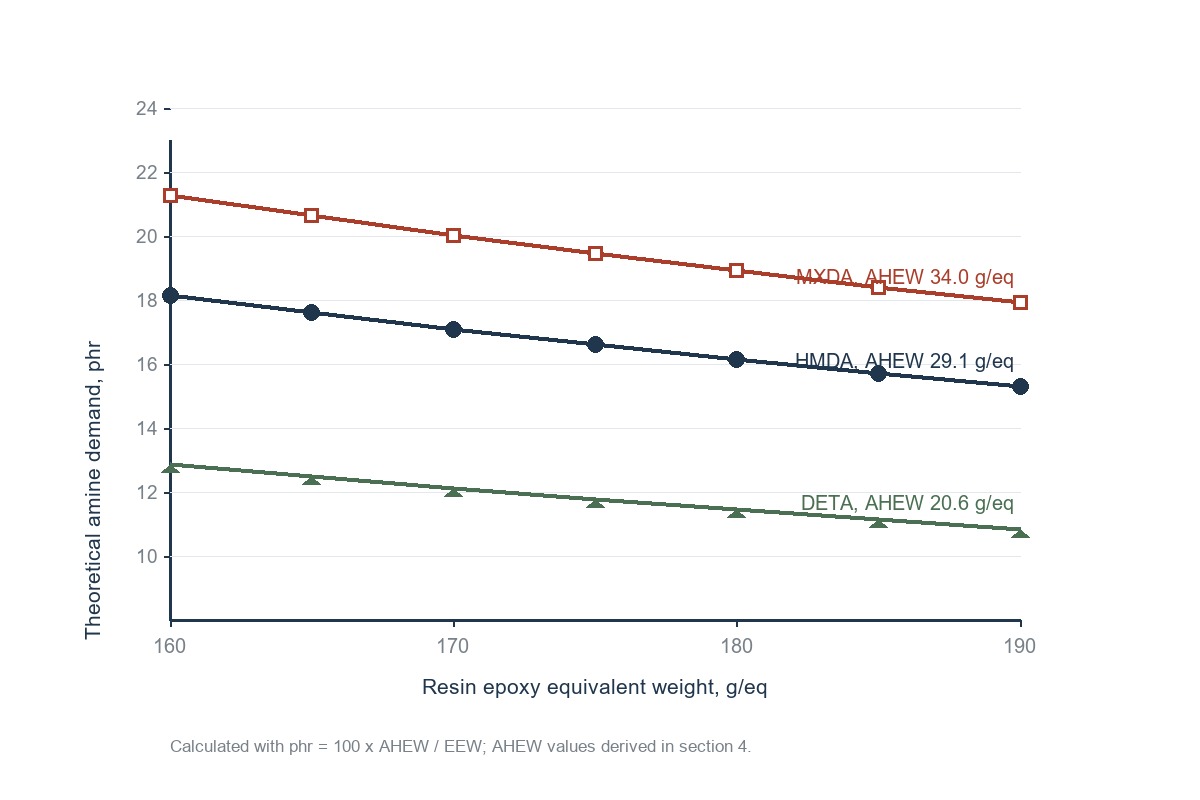
Figure 1. Calculated stoichiometric demand against resin epoxy equivalent weight for HMDA (29.1 g/eq), MXDA (34.0 g/eq) and DETA (20.6 g/eq); curves follow phr = 100 x AHEW / EEW as derived in section 4.
Straight-chain aliphatic diamines sit at the fast, high-crosslink-density end of the amine hardener range. 1,6-Hexanediamine is the shortest member that still keeps a flexible C6 spacer between its two primary amine groups, and four active hydrogens per molecule build a tight network at low loading, which is what high-solids coatings and rigid adhesive formulations ask for.
The same shortness creates the two practical problems quantified below. A literature melting point of about 41-42 °C, absent from the product page, means drums can wax in a cool warehouse. The strong ammonia odour, stated openly on the product page, rules out indoor work without forced ventilation. Selection depends on whether the formulation accepts those constraints in exchange for reactivity.
The grade is sold under the trade name HMDA, chemical name 1,6-hexanediamine, CAS 124-09-4. Four specification items are published on the product page: appearance, purity, water content and the PRI value. Everything else in this report is calculated from structure or marked as literature data, never presented as a published figure.
Table 1. Product identification of HMDA, with calculated and literature descriptors marked as such.
Item |
Information |
Trade name |
HMDA |
Chemical name |
1,6-Hexanediamine (hexamethylenediamine) |
CAS No. |
124-09-4 |
Molecular formula |
C6H16N2 (literature) |
Active hydrogens per molecule |
4, from two primary amine groups (calculated) |
Amine hydrogen equivalent weight |
29.1 g/eq (calculated, 116.2 / 4) |
Product page |
Table 2. Published specification items on the product page.
Property |
Published value |
Appearance |
Colorless to pale yellow liquid |
Purity, % |
Min. 99.90 |
Water, % |
Max. 0.05 |
PRI value, mmol/t |
Max. 100 |
The liquid appearance on the specification sheet deserves one comment. A diamine that solidifies at about 41-42 °C stays liquid only in warm storage, so check the drum temperature before assuming the contents are pourable.
Three data classes are kept apart. Published values come from the product page and its certificate documents. Calculated values, such as the 29.1 g/eq equivalent weight, follow from the molecular weight of 116.2 g/mol and four active hydrogens, and any reader can recompute them. Literature values, such as the melting point, are labelled as such and should be confirmed against the TDS and MSDS supplied with each lot.
Where a formulation example is needed, the resin baseline is the bisphenol A liquid grade YLE-128 with an epoxy equivalent weight of 184-190 g/eq; all arithmetic is performed at the mid-point of 187 g/eq, and every demand figure in section 4 follows the same division. Purity enters as shipped, since the 99.90% floor leaves at most 0.1% for correction, less than normal plant weighing error.
Two primary amines on a straight C6 chain give four hydrogens of nearly equal reactivity, so gelation arrives early and the exotherm is front-loaded. No steric shielding and no ether oxygen slow the addition, so this diamine reaches handle strength faster than ether-extended adducts at equal loading.
The C6 spacer moderates the brittleness short diamines usually cause. Six carbons between the nitrogen nodes let the network deform before it cracks, a small but real gain over ethylene diamine type structures. The gain is relative: against polyetheramines or adducts the film stays harder and less forgiving.
Humidity sensitivity is the weak point. The product page states that the material absorbs water and carbon dioxide from air. Carbamate on exposed amine surfaces shows up as blushing and poor intercoat adhesion, so open time in the mixer matters.
Table 3 compares the diamine with the polyamine alternatives stocked on the same site, all AHEW values determined by the same molecular-weight division for a fair basis. The choice depends on which constraint binds first: loading accuracy, odour, blush, or flexibility.
Table 3. Selection comparison of HMDA with alternative amine hardeners; equivalent weights and phr values are calculated against YLE-128 at 187 g/eq.
Attribute |
HMDA (this grade) |
Alternative polyamines |
AHEW, g/eq (calculated) |
29.1 |
DETA 20.6; MXDA 34.0; DMAPA 44.1; MACM 52.6 |
Stoichiometric phr in YLE-128 |
15.5 |
DETA 11.0; MXDA 18.2; DMAPA 23.6; MACM 28.1 |
Purity floor, % |
99.90 (published) |
DETA high-purity grade; others per their pages |
Form at 25 °C |
Solid below about 41-42 °C (literature); liquid when warm |
MXDA liquid; MACM low-melt solid |
Odour |
Very strong ammonia odour (published) |
Lower for MACM; MXDA sharper but less volatile |
Blush tendency |
High in humid air; absorbs CO2 and water (published) |
MACM lower; DETA also blush-prone |
Network character |
Dense and rigid, C6 spacer adds slight flex |
MXDA aromatic ring raises Tg; DMAPA tertiary N slows cure |
Read the table by constraint, not by column. If loading accuracy at high purity binds, the 99.90% floor and the 15.5 phr figure make the diamine easy to dose and audit. If blushing or odour binds, pick a cycloaliphatic hardener and accept the higher phr.
The stoichiometric rule is one line: phr = 100 x AHEW / EEW. With AHEW at 29.1 g/eq and the YLE-128 mid-point of 187 g/eq, demand is 100 x 29.1 / 187 = 15.5 phr. Every figure below follows from that division, with no hidden constant.
Table 4. Calculated stoichiometric demand of HMDA across three resin grades, with DETA shown for cross-checking.
Resin grade |
EEW, g/eq |
HMDA phr (calculated) |
HMDA kg per 100 kg resin |
DETA phr (calculated) |
YLE-127 |
180 |
16.1 |
16.1 |
11.4 |
YLE-128 |
187 |
15.5 |
15.5 |
11.0 |
YLE-170 (BPF) |
170 |
17.1 |
17.1 |
12.1 |
Two corrections sit on top. First, if the lot certificate reports an EEW of 191 g/eq, demand drops to 15.2 phr, so dose from the certificate rather than the datasheet mid-point. Second, under-dosing shows as a tacky surface at room temperature; half a phr of deviation is already visible, which makes this hardener less tolerant of sloppy weighing than higher-AHEW alternatives.
Mixing behaviour is unforgiving but predictable. The material wets epoxy resin quickly, the exotherm peaks early in a mass batch, and pot life at bench scale is short once the amine is in. Plan the pour before mixing, not after.
Workable practice, distilled from the published properties and the literature melting point:
- Warm waxed or solidified drums to 45-50 °C until fully liquid, then homogenise before weighing; unmelted lumps dose badly.
- Weigh the amine into the resin within minutes of opening the container. Air exposure builds carbamate skin that later reads as fish eyes in the film.
- Keep mixed mass thin during induction when the batch exceeds a few litres; the four-hydrogen structure releases heat fast and a thick pile can discolour.
- Ventilate the metering area. The published odour description is not a formality; operators judge leaks by smell long before instruments do.
- If a batch must wait, seal the part container with a nitrogen blanket or desiccant, because the water ceiling of 0.05% is easy to exceed through uptake from humid air.
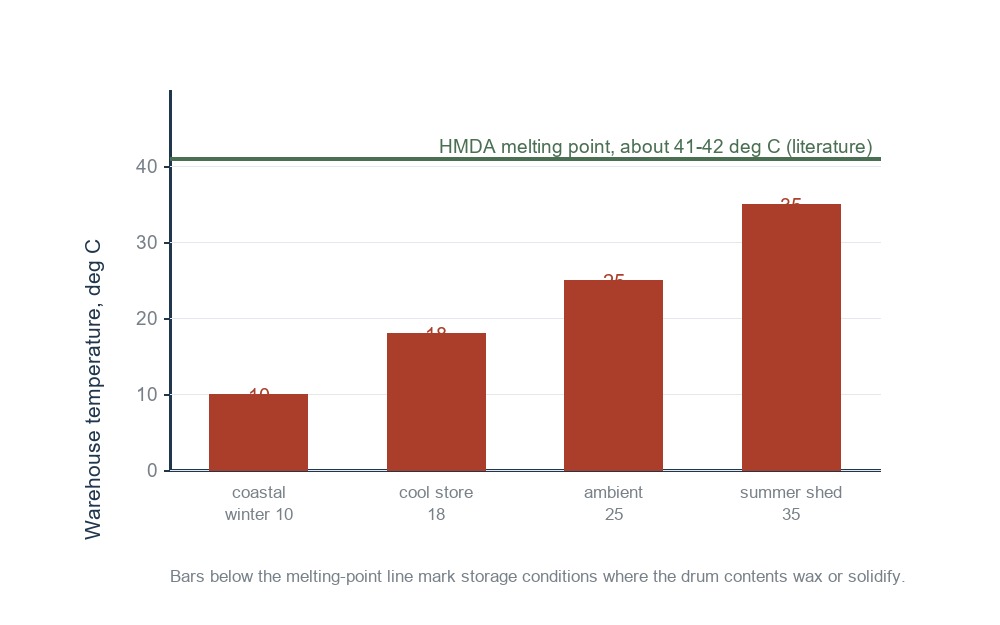
Figure 2. Storage temperature scenarios against the literature melting point of about 41-42 °C; bars below the green line mark conditions where drum contents wax or solidify.
Fit is best where reactivity and network density pay for themselves and appearance demands are modest. The four segments below all appear as application pages on this site; the table records why the diamine fits or does not.
Table 5. Application fit of HMDA by segment.
Segment |
Fit |
Reasoning |
Good with management |
Dense network resists chemicals; blush control needed in humid shops |
|
Good |
Fast strength build at 15.5 phr in YLE-128; C6 spacer keeps some flex |
|
Conditional |
Short pot life suits casting and lamination, not long layup schedules |
|
Clear decorative coats |
Poor |
Odour and carbamate blushing disqualify it where appearance leads |
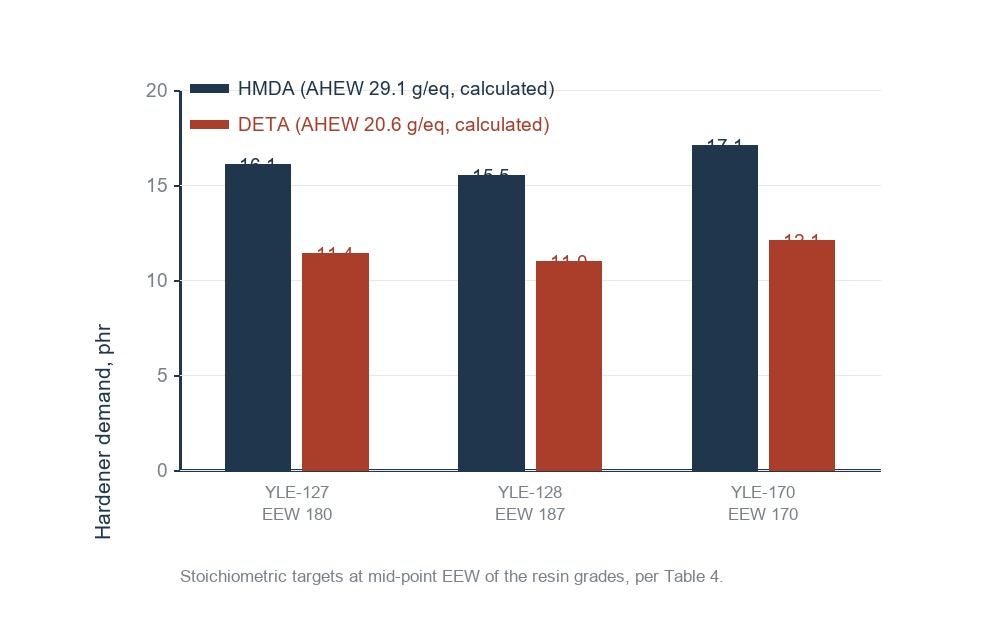
Figure 3. Calculated stoichiometric demand of HMDA versus DETA across the three standard resin grades, at the mid-point EEW of each published range.
Say it plainly: this hardener is the wrong choice for water-clear, low-blush finishes, for unventilated indoor work, and for formulations that must sit in an open container for hours. Odour and carbon dioxide uptake rule those uses out regardless of price.
Viscosity, epoxy equivalent weight of the amine adduct, and cure kinetics are not published on the product page, so any pot-life or film-property claim beyond the stoichiometry above would be speculation. When those properties matter to a design, request the current TDS and confirm by trial batch; the calculation method in section 4 transfers, but the measured numbers must come from the lot.
A duplicate titration on arrival is cheap insurance. Check purity and water against the certificate; the PRI ceiling of 100 mmol/t flags oxidised amine and is worth a spot check on every new lot.
Store drums sealed, off cold floors, above the waxing window in Figure 2. If a drum has solidified, melt once at 45-50 °C and use it soon; repeated melt-solidify cycles waste colour stability and can raise the PRI reading. Packaging and shelf life follow the product page documents.
15.5 phr at a resin EEW of 187 g/eq, calculated as 100 x 29.1 / 187. Dose from the lot certificate EEW when one exists, because a 191 g/eq lot needs 15.2 phr instead.
The literature melting point is about 41-42 °C, so any storage below that lets the contents crystallise. Warm the sealed drum to 45-50 °C, homogenise, and weigh soon after.
Not faster per equivalent; DETA has the lower AHEW of 20.6 g/eq and gels quickly too. The difference is network density and loading, with HMDA at 15.5 phr against 11.0 phr in the same resin.
Rarely a good idea. Carbon dioxide uptake blushes the film and the ammonia odour needs extraction. Cycloaliphatic hardeners such as MACM serve clear work better.
It is the published ceiling for an oxidation-related index on the specification sheet. A rising PRI reading across lots signals amine oxidation, so track it during incoming inspection.
Calculated, from the molecular weight of 116.2 g/mol and four active hydrogens. It is not a published specification item, and any measured amine value from the certificate takes precedence for dosing.
As an HMDA epoxy curing agent, 1,6-hexanediamine earns its place where a dense, fast-building network at a modest 15.5 phr matters more than cosmetics. The 99.90% purity floor and 0.05% water ceiling make dosing auditable, and the arithmetic behind every figure in this report is one division a formulator can repeat. Melting behaviour and odour are the two constraints; both are manageable with warmed drums and ventilation, and both argue for cycloaliphatic or adduct hardeners when appearance leads the specification.
1. Yolatech product page: HMDA, 1,6-Hexanediamine, CAS 124-09-4, https://www.yolatech.com/16-hexanediamine-hmda-cas-124-09-4
2. HMDA technical data sheet, material safety data sheet and certificate of analysis, supplied with each commercial lot.
3. ASTM D1652, standard test practice for epoxy content of epoxy resins, used as the reference basis for resin EEW values.
4. ISO 3001, plastics, epoxy compounds, determination of epoxy equivalent weight.
5. ASTM E203, standard test method for water using volumetric Karl Fischer titration, referenced for the water ceiling.

 IPv6-Netzwerk unterstützt