


Sprache
:

Sprache
:
YLH-6005 is a low viscosity epoxy hardener built on a nonylphenol-free modified polyetheramine with AHEW 95 g/eq and 250–450 cps at 25 °C. It carries 50 phr against an EEW 190 resin, and this report ranks it here against four in-house grades on gel time, colour, hardness build and flexural strength.
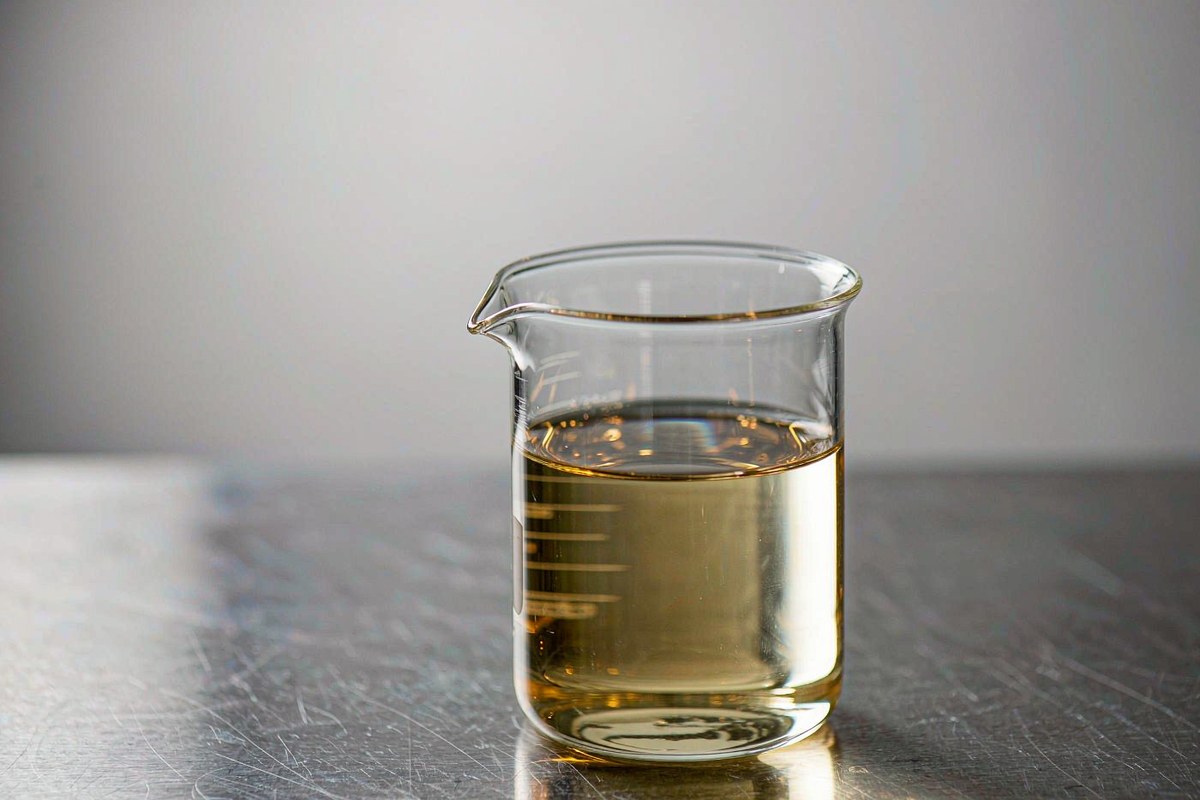
Figure 1. YLH-6005 as supplied: a light yellow liquid in the 250–450 cps band, the viscosity that keeps a self-levelling floor mix workable.
A contractor choosing between five amine hardeners is choosing which property to give up. YLH-6005 gives up colour and some flexural strength to gain the fastest gel in the low-viscosity group: 23 min against 30 to 50 min.
Four modified amine hardeners share the 250–12000 cps envelope and one test reference, a liquid bisphenol A resin of EEW 190, so published numbers read across without extrapolation.
Scope stops at ambient cure: flooring and electronic potting. Laminating and anhydride chemistry sit outside.
YLH-6005 ships as a light yellow liquid in drums, with at least 12 months of shelf life unopened at ambient. No CAS number is published, so identification depends on the grade name and the lot COA.
Table 1. Product identification of YLH-6005 as published by the supplier.
Item |
Detail |
Grade |
YLH-6005 |
Chemistry |
Modified polyetheramine, nonylphenol-free |
Appearance |
Light yellow, transparent liquid |
CAS number |
Not published; confirm on the COA |
Packaging |
Drum; net weight not published |
Table 2. Published physical and cure properties of YLH-6005, with the basis behind each number.
Property |
Value |
Basis |
Colour, Gardner |
Max. 3 |
ASTM D1544 |
Viscosity at 25 °C |
250–450 cps |
Supplier data |
AHEW |
95 g/eq |
Supplier data |
Amine value |
270 mg KOH/g |
ISO 9702 |
Density at 25 °C |
1.02 g/cm3 |
Supplier data |
Added weight |
50 phr |
Calculated at EEW 190 |
Gel time, 100 g at 25 °C |
23 min |
Shop test |
Thin-film set, 15 g at 3 mm |
2.5 h |
Shop test |
Shore D 70, 15 g at 3 mm |
10 h |
Shop test |
Bending strength |
82.3 MPa |
EEW 190 reference |
One entry is derived, not measured: the 50 phr added weight is 100 × 95 ÷ 190, the stoichiometric ratio for the reference resin, so it tracks resin EEW.
Colour is a Gardner maximum measured at 25 °C per ASTM D1544, and viscosity a 25 °C figure. Resin epoxy content follows ASTM D1652; amine value on an incoming drum is normally determined by ISO 9702.
Gel time, thin-film set and Shore D build are shop tests, not cure kinetics. They rest on 100 g of mixed mass and a 15 g film at 3 mm, without a standard deviation or replicates.
AHEW 95 g/eq fixes the stoichiometry: 50 phr against the EEW 190 reference resin, which makes the hardener 33% of the mixed weight.
Two grades share that ratio: YLH-6005 at AHEW 95 and YLH-6004 at 96 g/eq. Their gel times differ twofold, 23 min against 50 min, which equivalence cannot explain.
Amine value is not a shortcut to AHEW. Dividing 56100 by 270 returns 208 g/eq against a published 95 g/eq, so the two figures sit on different bases. Use AHEW for dosage and amine value as a lot fingerprint.
Five grades cover the band, all tested against the same EEW 190 resin, so Table 3 reads across.
Table 3. Published properties of five ambient-cure amine hardeners, tested against a liquid bisphenol A resin of EEW 190.
Grade |
Chemistry |
Viscosity, cps |
AHEW, g/eq |
phr at EEW 190 |
Gel time |
Thin-film set |
Shore D 70 |
Bending |
YLH-6005 |
Polyetheramine, NP-free |
250–450 |
95 |
50 phr |
23 min |
2.5 h |
10 h |
82.3 MPa |
YLH-6004 |
Polyetheramine, NP-free |
100–300 |
96 |
50 phr |
50 min |
3.8 h |
15 h |
96.3 MPa |
Cycloaliphatic, low VOC |
250–450 |
92 |
48 phr |
30 min |
2.8 h |
8 h |
Not published |
|
YLH-3023 |
Cycloaliphatic |
250–500 |
100 |
52 phr |
30 min |
2.3 h |
7 h |
78 MPa |
YLH-3002 |
Cycloaliphatic |
5000–12000 |
182 |
96 phr |
30 min |
1.5 h |
6 h |
84.1 MPa |
Read it by constraint, not rank. YLH-6005 leads on gel time and trails on colour at Gardner max. 3 against max. 1 for YLH-3023. YLH-6004 is slowest but strongest at 96.3 MPa.
YLH-3002 sits at 5000–12000 cps and needs 96 phr, nearly twice the mass per kilo of resin. That is a design for working life in thick sections.
Four questions settle most enquiries.
Table 4. Selection matrix for ambient-cure amine hardeners, ordered by constraint.
Constraint |
Threshold |
Grade that fits |
What you give up |
Fast return to service |
Set under 3 h |
YLH-6005, 2.5 h |
Colour, flexural strength |
Light-stable topcoat |
Gardner 2 or less |
YLH-3023, max. 1 |
NP-free declaration |
Highest flexural strength |
Above 90 MPa |
YLH-6004, 96.3 MPa |
3.8 h set, thin viscosity |
Thick-section casting |
High phr, low amine density |
YLH-3002, 96 phr |
Mix near 10600 mPa·s |
Nonylphenol-free audit |
Written declaration |
YLH-6005 or YLH-6004 |
Speed or colour |
Speed comes first: a missed recoat window costs a shift, while one Gardner point vanishes under a pigmented topcoat. If the coating is clear or light-tinted, the order reverses.
Dosage for a low viscosity epoxy hardener is one line of arithmetic: phr = 100 × AHEW ÷ EEW. At AHEW 95 that reduces to 9500 ÷ EEW, so the fraction falls as resin EEW rises.
Table 5. Hardener requirement for four resin EEW values at AHEW 95, with the split for a 20 kg kit.
Resin EEW, g/eq |
Hardener, phr |
Resin:hardener |
Resin in 20 kg |
Hardener in 20 kg |
190 |
50.0 phr |
2.00:1 |
13.33 kg |
6.67 kg |
184 |
51.6 phr |
1.94:1 |
13.19 kg |
6.81 kg |
170 |
55.9 phr |
1.79:1 |
12.83 kg |
7.17 kg |
205 |
46.3 phr |
2.16:1 |
13.67 kg |
6.33 kg |
Weigh to within 1% of the hardener figure. A 2% error shifts cure speed and hardness without ruining a floor. A 10% error leaves a tacky film that never hardens, however long you wait.
Blend arithmetic follows the same rule: 70 parts of EEW 190 resin with 30 parts of a 250 g/eq resin gives 205 g/eq, the last row above.
• Weigh, do not volume-measure. At 1.02 g/cm3 against roughly 1.16 for the resin, using the 2:1 weight ratio by volume under-doses hardener by 12%.
• Mix 2 to 3 min at low shear. Air whipped in shows as pinholes in a self-levelling film and cannot be walked out.
• Treat 23 min as an upper bound: it was measured on 100 g, and a 1 kg batch holds its heat and gels sooner.
• Recoat between the 2.5 h set and the 10 h Shore D 70 point. If the film is past full cure, abrade before the next coat.
• Below 15 °C the reaction slows and the film may stay tacky overnight. Above 30 °C pot life roughly halves.
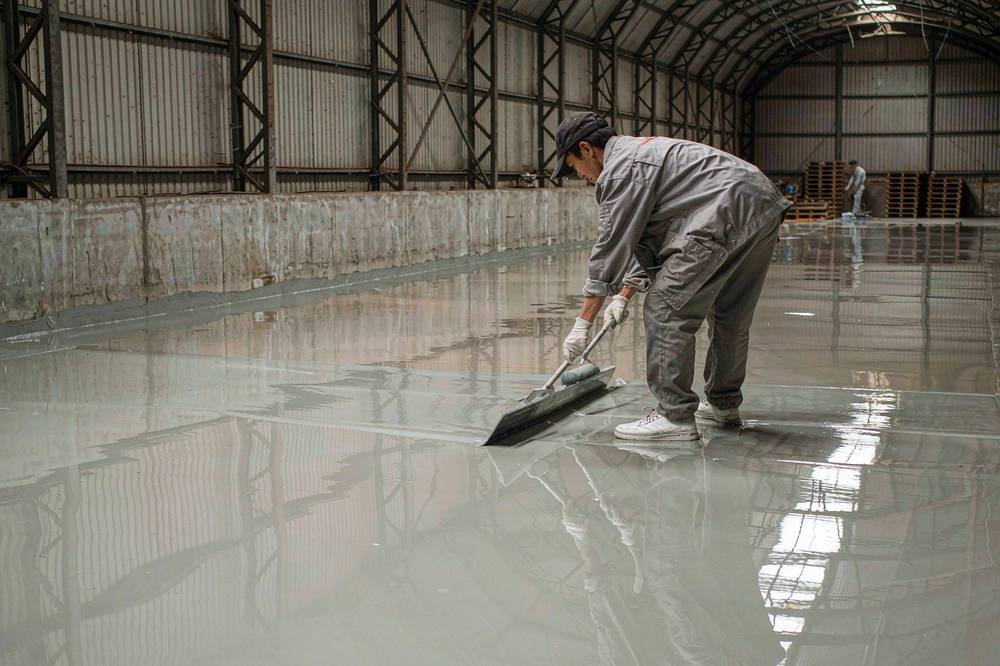
Figure 2. Applying a self-levelling epoxy floor coating; a 2.5 h thin-film set keeps the recoat window inside the same shift.
The mix thins sharply: 50 phr of a 350 cps hardener takes a 13000 mPa·s resin to about 3900 mPa·s on a logarithmic mixing rule. That is what makes a solvent-free self-levelling grade practical.
Two applications are published: epoxy flooring and electronic potting. They pull in opposite directions on cure speed.
Table 6. Published applications of YLH-6005, with the property that governs each one.
Application |
Role of the hardener |
Governing property |
Watch point |
Self-levelling floor |
Curing agent at 50 phr |
23 min gel, 250–450 cps |
Recoat window |
Mortar and screed |
Binder with graded filler |
2.5 h thin-film set |
Filler lifts mix viscosity |
Clear or tinted topcoat |
Curing agent at 50 phr |
Gardner max. 3 |
Colour against max. 1 grades |
Electronic potting |
Curing agent, filled system |
10 h to Shore D 70 |
Exotherm above 1 kg pours |
Flooring is the intended use; the blush-free claim is scoped to a topcoat on flooring, not every climate.
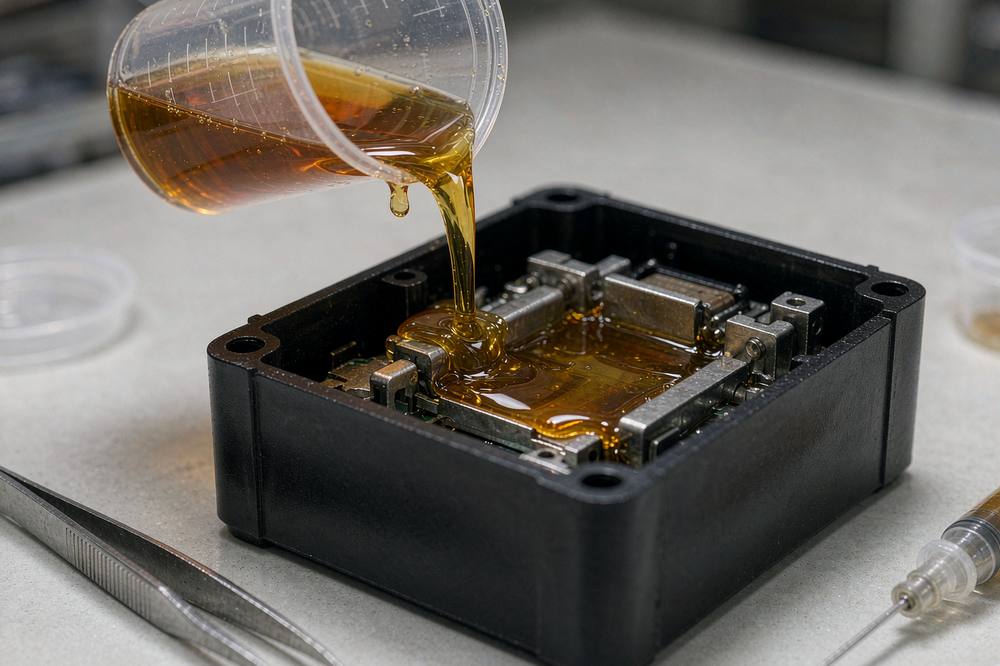
Figure 3. Potting a small electronic housing; gel time and exotherm, not hardness, set the size limit for a poured mass.
Potting is where fast gel bites. A 23 min gel on 100 g scales badly: a 2 kg pour in an insulating housing can exotherm enough to crack around inserts. Above that mass, YLH-6004 at 50 min is safer.
Three published numbers argue against YLH-6005 in specific jobs. Gardner max. 3 rules out water-clear topcoats, 82.3 MPa bending is the lowest of the three grades publishing mechanical data, and a 23 min gel limits poured mass.
Two gaps matter more. No CAS number is published, so customs and any REACH screening need the COA. Amine value and AHEW also fail to reconcile, so verify both on the first drum.
It is also wrong where a specification asks for over 45 min of pot life at 25 °C solvent-free. Nothing published supports that.
A first-drum check covers Gardner colour by ASTM D1544, viscosity at 25 °C, amine value by ISO 9702 and water content by ASTM E203. Add a 100 g gel time if the line is rate-sensitive.
Packaging is a drum, net weight not published, and shelf life at least 12 months in unopened packing at ambient. Keep the cap closed: a modified amine picks up moisture and carbon dioxide, and the film degrades before the titration shows it.
Storage needs ventilation, no flame and no direct sunlight. The hardener is alkaline and irritant, so gloves and eye protection are the minimum and the MSDS governs handling and disposal. RoHS or REACH statements belong on the COA, not here.
At AHEW 95 g/eq it is 50 phr on an EEW 190 resin, or 2.00:1 by weight. An EEW 184 resin needs 51.6 phr, an EEW 170 resin 55.9 phr.
No. Both take 50 phr, yet gel times are 23 min and 50 min. Swapping changes the recoat schedule, and YLH-6004 gives more flexural strength at 96.3 MPa.
The supplier states no blushing on top of epoxy flooring coatings. Blush is a reaction between amine, moisture and carbon dioxide, so cold damp weather can still produce it.
Electronic potting is a published application, with Shore D 70 in 10 h on a 15 g film. Above a 1 kg pour, use a slower grade.
None is published. Request it on the COA or TDS before the first shipment; customs and safety documents usually need it.
It is declared nonylphenol-free on the product page. That is a formulation statement, not a certification, so get it in writing on the TDS if a customer audits.
Among five ambient-cure amine hardeners, YLH-6005 is the fast option: 23 min gel and 2.5 h thin-film set against 30 to 50 min.
Stoichiometry is plain: 50 phr at EEW 190, 55.9 phr on a 170 g/eq resin. The cost is Gardner max. 3 and 82.3 MPa flexure.
Where speed governs, trial YLH-6005. Where colour or flexure governs, YLH-3023 at 30 min and YLH-6004 at 96.3 MPa answer better.
Yolatech product page for YLH-6005: https://www.yolatech.com/curing-agnet-ylh-6005 (accessed 2026-11-04).
Datasheet page for YLH-6004 at https://www.yolatech.com/curing-agnet-ylh-6004 (accessed 2026-11-04).
Datasheet page for YLH-3002 at https://www.yolatech.com/curing-agnet-ylh-3002 (accessed 2026-11-04).
Yolatech TDS, MSDS and COA for YLH-6005, carrying the lot CAS number; available on request.
ASTM D1544, Gardner colour of transparent liquids, the method behind the colour maximum.
ISO 9702, amine group nitrogen content of amine epoxide hardeners.
ASTM E203, water content by Karl Fischer titration.
ASTM D1652, epoxy content of epoxy resins (EEW).

 IPv6-Netzwerk unterstützt