Solution Type Phenolic Epoxy Resin: 80% Solids Dosage Math
Nov 06, 2026
Solution type phenolic epoxy resin is a multifunctional novolac epoxy supplied as an 80% solids solution, in EEW 170-220 g/eq grades on solids. Two grades are listed, YLEP-210-A80 and YLEP-180-K80. Hardener dosage belongs on the solution supplied, not on solids. Dilution adds 25% to the working EEW.
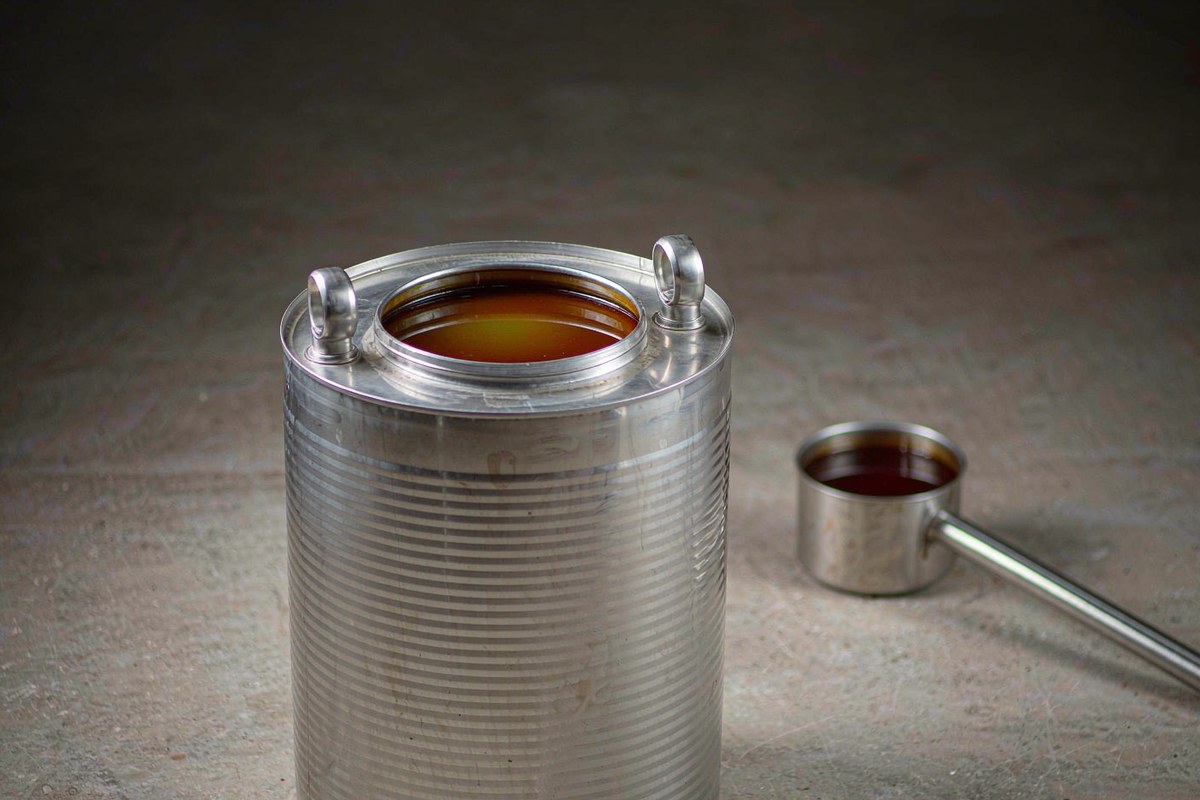
Figure 1. Drum supply of an 80% solids phenolic epoxy solution, the form most impregnation lines receive.
1. Introduction
Novolac epoxy starts from a phenol-formaldehyde condensate, not from bisphenol A. Epoxidising that condensate gives more than two glycidyl groups per molecule, and the cured network reaches higher crosslink density than a bisphenol A system.
Heat, solvent and chemical resistance and dimensional stability rise with that density. Brittleness rises too, and adhesion to copper foil falls. Formulators blend in a bisphenol A resin for toughness and adjust cure for copper grip.
Both grades on the product page ship at 80% solids, the form impregnation lines actually buy. That number sits between the datasheet and every downstream figure: hardener weight, bath viscosity, volatile content, cost per equivalent.
Values below come from the public solution type phenolic epoxy resin product page, read on 2026-11-06; calculated figures are labelled as such.
2. Materials and Methods: Solution Type Phenolic Epoxy Resin Grades
2.1 Product Identification and Specification
Table 1 reproduces both grades as published, without rounding.
Table 1. Published specification of the two 80% solids grades, EEW quoted on resin solids.
Grade
EEW (g/eq)
Viscosity (mPa·s)
N.V. (%)
YLEP-210-A80
200-220
1000-4000
80±1
YLEP-180-K80
170-190
200-500
80±1
No CAS number, formula, solvent identity or functionality is published for either grade; those fields stay open rather than being imported.
2.2 Test Methods and Data Sources
EEW for a solution grade is normally determined by titration according to ASTM D1652 or ISO 3001, and quoted per gram of solids. Viscosity is rotational, measured at 25 °C. Colour follows ASTM D1544; water follows ASTM E203.
Calculated values carry their formula. Values labelled empirical are practice-based starting points and were not run in triplicate here. Where the page is silent, the text says not published.
3. Results and Discussion
3.1 Structure and Reactivity: Why 80% Solids Moves Dosage
Dilution is where dosage errors start. The published 200-220 g/eq describes resin solids, while the drum holds 20% solvent. Per gram of liquid as supplied the equivalent weight becomes 250-275 g/eq, from 200 ÷ 0.80 and 220 ÷ 0.80.
YLEP-180-K80 moves the same way, from 170-190 g/eq on solids to 212.5-237.5 g/eq as supplied. Equivalents per kilogram run inverse: 4.00 eq/kg at 250 g/eq, 3.64 eq/kg at 275 g/eq, 4.71 eq/kg for K80 at 212.5 g/eq.
A 90% bisphenol A solution such as YLE-128A90 lands at 204-216 g/eq as supplied, which is 4.6-4.9 eq/kg. The phenolic grades therefore deliver fewer equivalents per kilogram of purchased liquid. That gap is paid in freight as well as resin.
Substitution on the ring shifts the balance inside the family. CNE grades carry a methyl group ortho to the ether linkage and beat PNE grades on water resistance and melt viscosity, while BNE grades reach a DDS-cured Tg of 224 °C. Neither solution grade states its functionality, and 2.7 epoxy groups per molecule is published only for YLEP-631.
3.2 Comparison with Alternative Systems
Table 2 puts both solution grades beside the nearest solid novolac and a standard bisphenol A solution, using published values only.
Table 2. Attribute comparison with a solid novolac and a 90% bisphenol A solution.
Attribute
YLEP-210-A80
YLEP-638 solid
YLE-128A90
Delivery form
80% solution
Semi-solid
90% solution
EEW on solids, g/eq
200-220
170-190
184-194
Solids content, %
80±1
100
90±1
EEW as supplied, g/eq
250-275
170-190
204-216
Viscosity
1000-4000 mPa·s
36-40 °C softening
≤1000 mPa·s
Hydrolyzable chlorine
Not published
≤500 ppm
Not published
Epoxy groups per molecule
Not published
Not published
2
Main use on datasheet
Laminate varnish
High-temperature laminate
General laminating
The trade-off sits in two rows. YLEP-638 gives the same novolac backbone at 170-190 g/eq with no solvent to evaporate, but its 36-40 °C softening point forces a melt step and hydrolyzable chlorine is capped at 500 ppm. In practice a plant with a solvent line prefers the solution; one without should stay with flake.
Solvent is never free. At a density near 1.05-1.10 kg/L, 20% solvent works out to roughly 210-220 g/L of volatile content.
4. Formulation and Dosage Calculation: phr on the As-Supplied Solution
Three equations cover the work.
As-supplied EEW equals solids EEW divided by the solids fraction, EEW_s = EEW_solids ÷ (N.V. ÷ 100). Amine demand follows phr = 100 × AHEW ÷ EEW_s, with AHEW at 20.6 g/eq for DETA, 21.0 g/eq for dicyandiamide and 62.1 g/eq for diaminodiphenylsulfone.
Table 3. Hardener demand per 100 g of solution, calculated from as-supplied EEW.
EEW as supplied (g/eq)
DETA, phr
DICY, phr
DDS, phr
212.5 (K80 low)
9.69
9.88
29.22
237.5 (K80 high)
8.67
8.84
26.15
250 (A80 low)
8.24
8.40
24.84
262.5 (A80 middle)
7.85
8.00
23.66
275 (A80 high)
7.49
7.64
22.58
At 250 g/eq the figures read 8.24 phr of DETA and 8.40 phr of DICY per 100 g of solution. At 275 g/eq they fall to 7.49 and 7.64 phr, a 9% swing across one band. Buy the narrowest band the supplier will commit to, or dose against the COA.
The common error is skipping the dilution. Treating YLEP-210-A80 as a 210 g/eq resin gives 9.81 phr of DETA against a correct 8.24 phr, a 19% amine excess that plasticises the network and raises water uptake. If a batch stays tacky, check whether dosage was figured on solids before adding accelerator.
Thinning is arithmetic. Per 100 kg of 80% solution there are 80 kg of solids, and the solvent needed to reach a target N.V. is 80 ÷ (target ÷ 100) − 100.
Table 4. Solvent addition from 100 kg of 80% solution at 200 g/eq solids.
Target N.V. (%)
Solvent to add (kg)
Final batch (kg)
EEW as supplied (g/eq)
75
6.7
106.7
266.7
70
14.3
114.3
285.7
65
23.1
123.1
307.7
60
33.3
133.3
333.3
Blending often beats thinning. Equal masses of the two grades give 2 ÷ (1 ÷ 250 + 1 ÷ 212.5) = 230 g/eq as supplied. Viscosity follows a logarithmic mixing rule, ln η = Σ w ln η, which for 2500 and 350 mPa·s at equal weights predicts about 935 mPa·s.
5. Processing Notes and Operating Window
The window is set by solvent loss, not by the resin.
• Mix at 30-40 °C; a cold solution traps air that shows up as pinholes.
• Hold the bath at 20-25 °C. Every 10 °C of extra heat halves the working life of an accelerated DICY system.
• Measure solids on the bath, not only on the drum. N.V. can climb several points in one shift.
• Stage the cure: 30 min at 90 °C before gel. Straight to 160 °C blisters the laminate unless the section is thin.
• Filter before use; novolac solutions throw a sediment that scorches under a hot press.
Figure 2. Impregnation bath running an 80% solids novolac varnish, with solids checked on the bath.
Pot life at 25 °C is typically 8-24 h for a DICY varnish and minutes for a DETA mix, so DETA belongs in small batches. A bath left open all afternoon will not behave like the morning sample even at the same N.V.
6. Applications
Six applications are listed, and the two grades do not serve them equally.
Table 5. Application map for the two grades, from the list on the product page.
Application
Function of the solution
Grade fit
Process note
Copper-clad laminate
Impregnation varnish
YLEP-210-A80
Hold N.V. to control flow
Electronic laminate
Prepreg resin with DICY
Both grades
Control stage B
Heat-resistant adhesive
Structural bondline
YLEP-210-A80
Cure above 160 °C
Heat-resistant coating
Baked or ambient film
YLEP-180-K80
Low band suits spray
Civil engineering
Solvent-borne primer
YLEP-180-K80
Long open time
Electronic ink
Vehicle for screen ink
YLEP-210-A80
Solvent balance sets levelling
Copper-clad laminate takes YLEP-210-A80, where the higher EEW tolerates a stiffer varnish. Spray and primer work takes YLEP-180-K80, whose 200-500 mPa·s band atomises without extra thinning.
Figure 3. Heat-resistant coating applied from a thinned solution; the K80 grade sprays at supplied viscosity.
7. Limitations and Material Verification
7.1 Known Limitations and Where These Grades Do Not Fit
These are solutions, which rules out several jobs. Solvent-free casting is not one: 20% volatile content boils at gel and leaves voids in a thick section. Neat metal bonding is a poor fit too, because the cured novolac is brittle and grips copper less firmly than bisphenol A.
Three fields are unpublished and should be confirmed before a specification is frozen: solvent identity, functionality and hydrolyzable chlorine. Swapping a glycol ether for an aromatic solvent changes water pick-up and evaporation, so check with the supplier before the swap; the press will show blisters otherwise.
The EEW basis is the fourth check. If the COA states EEW as supplied, do not divide by 0.80 again; that under-doses hardener by about 20% and leaves a tacky laminate.
7.2 Incoming Inspection, Packaging, Storage and Safety
Incoming inspection covers four numbers per lot: EEW by ASTM D1652 or ISO 3001, viscosity by ASTM D445 at 25 °C, colour by ASTM D1544 and water by ASTM E203. Keep a 200 g sample per batch; it settles arguments later when a lot drifts by 3 g/eq.
Packaging is drums, with at least 12 months shelf life from manufacture in original packing at ambient temperature. Store ventilated, away from flame and direct sunlight, and close the cap after use: an open drum skins over.
Safety information sits in the MSDS and the TDS governs the specification. Confirm handling, labelling and transport classification before shipping, and treat any RoHS or REACH statement as needing documentary confirmation rather than as a granted certification.
8. Frequently Asked Questions
What does 80% solids mean for hardener dosage?
The labelled EEW is divided by 0.80 before use. YLEP-210-A80 at 200-220 g/eq on solids becomes 250-275 g/eq as supplied, so DETA demand drops from 9.81 to 8.24 phr per 100 g.
Can YLEP-210-A80 replace a 100% solids novolac one for one?
No. Swapping it for a 170-190 g/eq solid grade removes about a quarter of the reactive mass per kilogram, so the batch needs more resin and less hardener.
Which grade suits a copper-clad laminate varnish?
YLEP-210-A80 is the usual starting point. Its higher EEW gives a stiffer prepreg, and the 1000-4000 mPa·s band leaves room for a flow promoter.
Does the solvent change pot life?
Indirectly. Solvent does not react, but it dilutes the reactants and slows the temperature rise, so a thinned mix can look long-lived in the bath and still gel quickly as a thin film.
What should the COA report for epoxy equivalent weight?
The value, the basis and the method. Ask for EEW in g/eq stating whether it refers to resin solids or to the solution as supplied, plus the titration standard used.
Is a 50/50 blend of the two grades practical?
Yes, and it is common. The blend lands near 230 g/eq as supplied with viscosity around 935 mPa·s, which suits lines that cannot run the 4000 mPa·s end of YLEP-210-A80.
9. Conclusions
Two 80% solids novolac grades cover EEW 170-220 g/eq on solids, which is 212.5-275 g/eq as supplied. Every hardener figure has to be computed on the as-supplied basis; skipping it over-doses amine by 19%.
The grades buy heat and solvent resistance with brittleness, lower copper adhesion and 20% volatile content. Where solvent cannot be tolerated, the solid novolac route on the phenolic epoxy resin range page remains correct, and the solution type bisphenol A epoxy resin line covers work needing more equivalents per kilogram.
10. References
Yolatech product page: https://www.yolatech.com/solution-type-phenolic-epoxy-resin (accessed 2026-11-06).
Technical Data Sheet for YLEP-210-A80 and YLEP-180-K80, 80% solids phenolic epoxy solution (available on request).
Certificate of Analysis (COA) for YLEP-210-A80, lot-specific EEW and solids (available on request).
ASTM D1652 and ISO 3001, titration routes for the epoxy content of epoxy resins (EEW).
ASTM D445, kinematic viscosity; ASTM D1544, Gardner color of transparent liquids.
ASTM E203, water content by Karl Fischer titration; ISO 9702, amine group nitrogen content of amine epoxide hardeners.
Mehr lesen






 IPv6-Netzwerk unterstützt