N,N-Dimethylanilin – Eine aromatische Aminverbindung, die in der Farbstoff- und Pharmazeutikasynthese verwendet wird
Jul 01, 2026
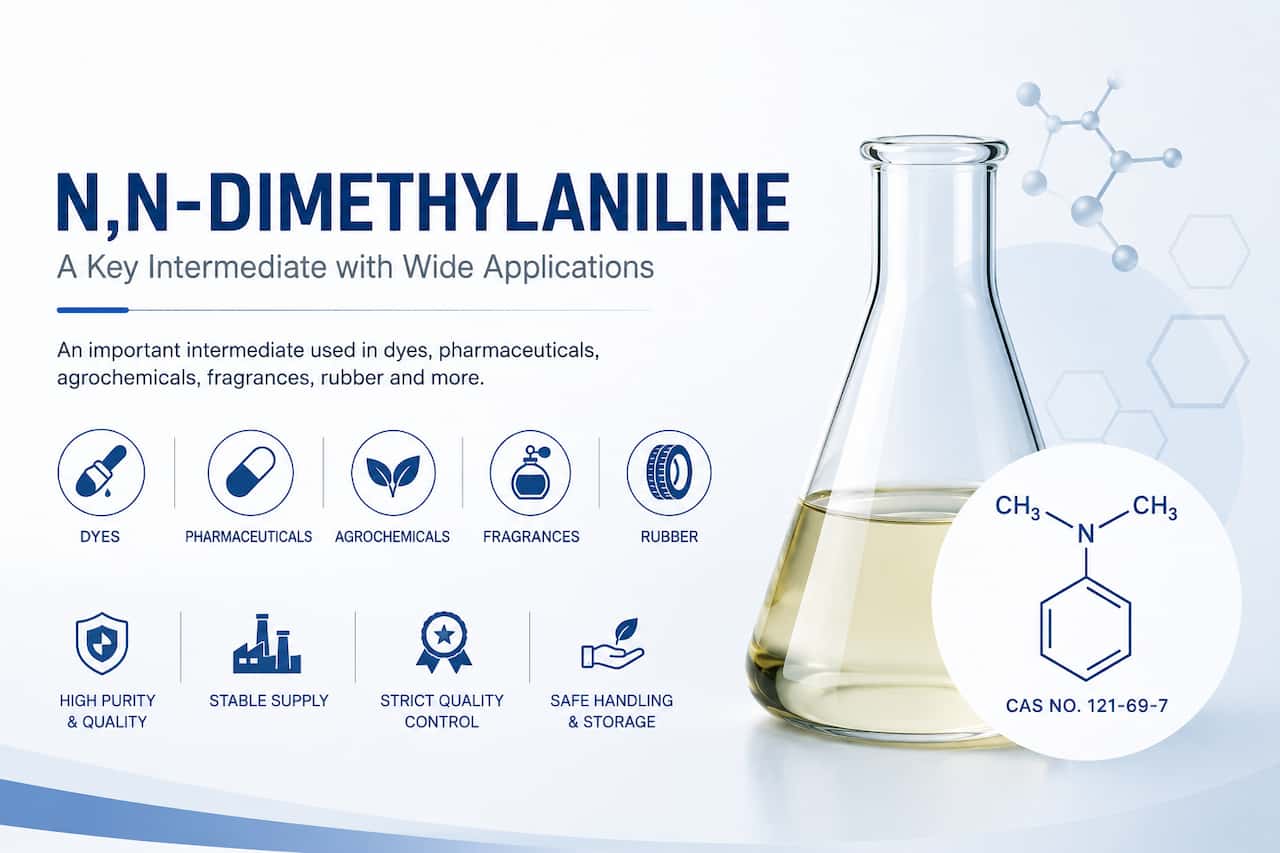
N,N-Dimethylanilin N,N-Dimethylanilin (chemische Formel: C₈H₁₁N) ist ein wichtiger organischer Rohstoff aus der Klasse der aromatischen Amine. Es entsteht durch die Substitution beider Wasserstoffatome der Aminogruppe von Anilin durch Methylgruppen. Bei Raumtemperatur erscheint N,N-Dimethylanilin als blassgelbe bis hellbraune, ölige Flüssigkeit mit einem charakteristischen stechenden, reizenden Geruch. Es ist in Wasser schwerlöslich, aber mit Ethanol, Diethylether, Chloroform und aromatischen organischen Lösungsmitteln mischbar. Als wichtiges Zwischenglied N,N-Dimethylanilin Es findet breite Anwendung in der Farbstoff-, Pharma-, Pestizid-, Duftstoff- und Kautschukindustrie. In der Farbstoffindustrie dient es als wichtiger Rohstoff für die Synthese von Triphenylmethanfarbstoffen (z. B. Basic Green, Victoria Blue) und Azofarbstoffen. In der Pharmaindustrie wird es zur Synthese verschiedener Arzneimittel, darunter Cephalosporin V und Sulfonamide, eingesetzt. Darüber hinaus dient es als Lösungsmittel, Härter für Epoxidharze und Vulkanisationsbeschleuniger für Kautschuk. Aufgrund seiner hohen Toxizität und der Einstufung als potenziell krebserregend ist die strikte Einhaltung von Sicherheitsvorkehrungen bei seiner Herstellung und Verwendung unerlässlich. Grundlegende InformationenChemischer NameN,N-DimethylanilinCAS-NR.121-69-7SynonymeDimethylanilin, Dimethylaminobenzol, N,N-XylidinAnwendungsgebieteFarbstoffe, Pharmazeutika, Pestizide, Gummi Entdeckungshintergrund und EntwicklungDie Entdeckung von N,N-Dimethylanilin ist eng mit der Revolution der Farbstoffindustrie im späten 19. und frühen 20. Jahrhundert verbunden. 1876 untersuchte der deutsche Chemiker Heinrich Caro, damals bei BASF tätig, die Synthese von Methylenblau. Diese umfasste Reaktionen mit N,N-Dimethylanilin und seinen Derivaten. Methylenblau war der weltweit erste synthetische Phenothiazinfarbstoff. Seine Synthese nutzte 4-Aminodimethylanilin und markierte den Beginn der Rolle von N,N-Dimethylanilin als unverzichtbarer chemischer Rohstoff. Mit dem starken Wachstum der Farbstoffindustrie stieg die Nachfrage nach N,N-Dimethylanilin sprunghaft an. Frühe Synthesemethoden basierten hauptsächlich auf der Hochtemperatur-Hochdruck-Kondensationsreaktion von Anilin mit Methanol in Gegenwart von Schwefelsäure. Dank technologischer Fortschritte haben gasphasenkatalytische Verfahren und kontinuierliche Produktionsprozesse mit festen Säurekatalysatoren die traditionellen diskontinuierlichen Flüssigphasenverfahren nach und nach abgelöst und so die Produktionseffizienz und Produktreinheit verbessert. China hat in der Produktionstechnologie von N,N-Dimethylanilin bereits bedeutende Fortschritte erzielt, wobei die kontinuierliche Verbesserung der Produktqualität und der Umweltstandards weiterhin im Gange ist. Physikalische und chemische EigenschaftenN,N-Dimethylanilin ist bei Raumtemperatur eine farblose bis blassgelbe, transparente, ölige Flüssigkeit. Bei längerer Einwirkung von Licht oder anderen Substanzen kann es oxidieren und sich rotbraun verfärben. Sein Schmelzpunkt liegt zwischen 1,5 und 2,5 °C, der Siedepunkt bei 193,1 °C. Die Substanz hat eine Dichte von etwa 0,96 g/cm³ und ist damit leichter als Wasser. Sie ist in Wasser schwerlöslich (Löslichkeit ca. 1 g/L bei 20 °C), aber mit vielen organischen Lösungsmitteln wie Ethanol, Diethylether, Chloroform und Benzol mischbar. Sie weist schwache Basizität auf; der pH-Wert einer 10%igen wässrigen Lösung beträgt etwa 7,49. N,N-Dimethylanilin weist typische Eigenschaften aromatischer Amine auf. Aufgrund der zwei an das Stickstoffatom gebundenen Methylgruppen ist seine Basizität stärker als die von Anilin, aber schwächer als die von aliphatischen Aminen. Es oxidiert leicht und dunkelt bei Kontakt mit Luft oder Sonnenlicht allmählich nach. Als Nukleophil kann es N-Methylierungs- oder C-Methylierungsreaktionen eingehen. Obwohl seine schwache Basizität die Diazotierung erschwert, kann sie unter stark sauren Bedingungen ablaufen; die Reaktion mit Natriumnitrit in saurem Medium liefert Nitrosoverbindungen, die sich unter alkalischen Bedingungen smaragdgrün färben. Darüber hinaus eignet es sich hervorragend als Kupplungsreagenz und reagiert mit Diazoniumsalzen zu Azofarbstoffen. Es kann auch Substitutionsreaktionen wie Halogenierung, Nitrierung und Sulfonierung eingehen, die typischerweise in para-Position zur Aminogruppe erfolgen. ZubereitungsmethodenIndustriell wird N,N-Dimethylanilin hauptsächlich durch Methylierung von Anilin hergestellt. Das gängigste Verfahren beinhaltet die Umsetzung von Anilin und Methanol in Gegenwart eines Katalysators, beispielsweise Schwefelsäure oder fester Säuren (z. B. SO₄²⁻/ZrO₂). Die Reaktion wird typischerweise bei hoher Temperatur und hohem Druck durchgeführt, wodurch ein Gemisch aus N-Methylanilin und N,N-Dimethylanilin entsteht. Aus diesem wird das hochreine Produkt durch Destillation abgetrennt. Alternativ kann die kontinuierliche Methylierung von Methanol und Anilin in einem Festbettreaktor mit einem Kupfer-Zink-basierten Katalysator erfolgen. Dieses Verfahren zeichnet sich durch hohe Umsätze und gute Selektivität aus. AnwendungsgebieteFarbstoffindustrieN,N-Dimethylanilin ist ein wichtiges Zwischenprodukt in der Farbstoffindustrie. Es wird häufig zur Synthese von Triphenylmethan-Basischem Farbstoff wie Basic Green, Victoria Blue, Basic Yellow und Basic Violet 5BN verwendet. Diese Farbstoffe finden breite Anwendung beim Färben von Baumwolle, Leinen und Viskosefasern sowie beim Einfärben von Papier und Leder. Darüber hinaus dient es zur Synthese von Azofarbstoffen und Indikatoren wie Methylorange. In der Duftstoffindustrie ist es ein wichtiger Rohstoff für die Herstellung von Vanillin und anderen Aromastoffen. PharmaindustrieIn der pharmazeutischen Industrie wird N,N-Dimethylanilin zur Synthese verschiedener Arzneimittel eingesetzt. Es ist ein wichtiger Rohstoff für die Synthese des Antibiotikums Cephalosporin V. Darüber hinaus findet es Verwendung bei der Synthese von Sulfonamid-Arzneimitteln wie Sulfadoxin und Sulfadimethoxin. Neben den genannten Arzneimitteln wird es auch zur Synthese anderer pharmazeutischer Wirkstoffe wie Flucytosin eingesetzt. Werkstoffe und andere AnwendungenIm Pflanzenschutzmittelsektor dient N,N-Dimethylanilin zur Synthese wichtiger Zwischenprodukte für Sulfonylharnstoff-Herbizide. In der Kautschukindustrie wird es als Vulkanisationsbeschleuniger eingesetzt und trägt so zur Verbesserung der Vulkanisationsgeschwindigkeit und der Kautschukeigenschaften bei. In der Werkstoffindustrie findet es Anwendung als Härtungsbeschleuniger für Epoxidharze und ungesättigte Polyesterharze sowie als Katalysator für Polyurethanschaum. SicherheitsinformationenToxikologische DatenN,N-Dimethylanilin ist hochgiftig und weist eine ähnliche, aber etwas geringere Toxizität als Anilin auf. Die orale LD₅₀ beträgt bei Ratten 1410 mg/kg, die dermale LD₅₀ bei Kaninchen 1770 mg/kg. Sowohl das Einatmen der Dämpfe als auch die Aufnahme über die Haut können zu Vergiftungen führen. Hauptsächlich schädigt es das Blut und das Nervensystem und verursacht Methämoglobinämie, die sich durch Zyanose (bläuliche Verfärbung der Haut und Schleimhäute), Kopfschmerzen, Schwindel, Übelkeit und weitere Symptome äußert. Die Internationale Agentur für Krebsforschung (IARC) der Weltgesundheitsorganisation (WHO) stufte N,N-Dimethylanilin 2017 als Karzinogen der Gruppe 3 ein. Dies bedeutet, dass die Beweislage für eine krebserregende Wirkung beim Menschen unzureichend, die für eine krebserregende Wirkung in Tierversuchen jedoch ausreichend ist. Erste Hilfe und SchutzBei Hautkontakt mit N,N-Dimethylanilin kontaminierte Kleidung sofort ausziehen und die Haut gründlich mit Wasser und Seife waschen. Bei Augenkontakt sofort mehrere Minuten lang mit reichlich fließendem Wasser oder Kochsalzlösung spülen und dabei die Augenlider gelegentlich anheben. Bei Einatmen die betroffene Person sofort an die frische Luft bringen, die Atemwege freihalten und bei Atembeschwerden Sauerstoff verabreichen. Bei Verschlucken Mund ausspülen, reichlich warmes Wasser trinken, Erbrechen auslösen, eine Magenspülung durchführen, Aktivkohle verabreichen und sofort einen Arzt aufsuchen. Beim Umgang mit dem Stoff selbstansaugende Filteratemschutzmasken (Halbmasken), Schutzbrillen, flüssigkeitsdichte Arbeitskleidung und ölbeständige Gummihandschuhe tragen. Für ausreichende Belüftung am Arbeitsplatz sorgen und Geräte geschlossen halten. UmweltgefahrenN,N-Dimethylanilin ist giftig für Wasserorganismen und kann in Gewässern langfristig schädliche Auswirkungen haben. Seine Dämpfe können mit Luft explosive Gemische bilden und sind bei Kontakt mit offenen Flammen oder starker Hitze leicht entzündlich. Daher muss seine Freisetzung in die Umwelt streng kontrolliert werden. Im Falle eines Verschüttens ist das Material mit Sand oder einem inerten Material aufzusaugen und umweltgerecht zu entsorgen.
Mehr lesen






 IPv6-Netzwerk unterstützt